Stop Losing Customers to Booking Mistakes — A Groomer's Mica Solution

Stop Losing Customers to Booking Mistakes — A Groomer's Mica Solution
For a pet groomer, the appointment schedule is the business. Every double-booking creates an angry customer who feels disrespected. Every empty slot represents revenue that will never be recovered. Every last-minute cancellation that goes unfilled takes money directly out of your pocket. When you operate on tight margins and rely on repeat business, scheduling errors are not just inconveniences — they are existential threats to your business.
Jake Morrison runs Paws on Wheels, a mobile dog grooming service based in Denver, Colorado. He operates out of a single converted van equipped with a grooming tub, dryer, and all the tools he needs. He has a growing roster of 80 regular clients who expect timely, consistent service. For two years, Jake managed his appointments using a paper calendar and the notes app on his phone. The system worked well enough when he had 30 clients. By the time he hit 60, it was a constant source of stress. Then came the incident that forced him to change.
The Incident That Cost Him a Client
A regular customer named Karen arrived at her home for a 10 AM appointment. Her golden retriever, Charlie, was already in the grooming van, excited for his bath. But when Jake checked his paper calendar, he saw that he had somehow booked two clients for the same 10 AM slot. The other customer had arrived five minutes earlier with a sheepdog that needed a full groom. Jake had to choose. He chose wrong. Karen left angry, and Charlie did not get his bath. Jake lost that client and, as he later learned, three referrals that Karen had planned to send his way. One scheduling mistake cost him an estimated $1,800 in annual recurring revenue plus the word-of-mouth referrals that are the lifeblood of a mobile grooming business.
The Problem — Why Pet Grooming Schedules Are Uniquely Difficult
Pet grooming appointments look simple on the surface, but they involve variables that make them more complex than typical service appointments. Jake was managing all of these manually:
Recurring Appointments Create Compounding Errors
Most grooming clients book on a recurring cycle. A typical poodle needs grooming every four to six weeks. A short-haired breed might go eight weeks between appointments. When a client reschedules, the entire rotation shifts. One change ripples through the whole schedule. In a paper-based system, a single erasure and rewrite could introduce errors that took weeks to discover.
Service Time Variance Makes Fixed Blocks Impossible
A full groom on a 70-pound Golden Retriever takes 90 minutes, including drying time. A nail trim and sanitary clip on a 10-pound Chihuahua takes 15 minutes. A deshedding treatment on a Husky can take two hours. Groomers cannot book appointments in fixed time blocks like hair salons often do. Each appointment has a unique duration based on breed, size, coat condition, and the services requested. Jake spent an average of 12 minutes per day just calculating appointment durations and adjusting his schedule.
Mobile Grooming Adds a Travel Variable
Mobile groomers face a complication that brick-and-mortar salons do not: travel time. Jake serves a 15-mile radius around central Denver. A 30-minute grooming appointment requires a 45-minute slot when you account for driving, parking, and setup. On a busy day with eight appointments, the travel overhead ate up 2 to 3 hours of what could have been billable time. Without a system that accounted for travel, Jake often found himself running behind and rushing through grooms.
Seasonal Demand Spikes
Spring shedding season brings a flood of deshedding appointments. Summer means pre-vacation grooms from boarding clients. December is holiday photo prep season. During these peaks, Jake's paper calendar became unmanageable. He would take bookings on his phone during the day and forget to transfer them to the paper calendar at night. The next morning, he would discover double-bookings that required awkward phone calls to apologize and reschedule.
The Solution — One Prompt, One Complete Scheduling System
After the Karen incident, Jake knew he needed a proper system. He did not want to pay $50 a month for a grooming-specific booking app. He did not want to learn complex scheduling software. He wanted something simple, local, and flexible. He opened Mica and typed:
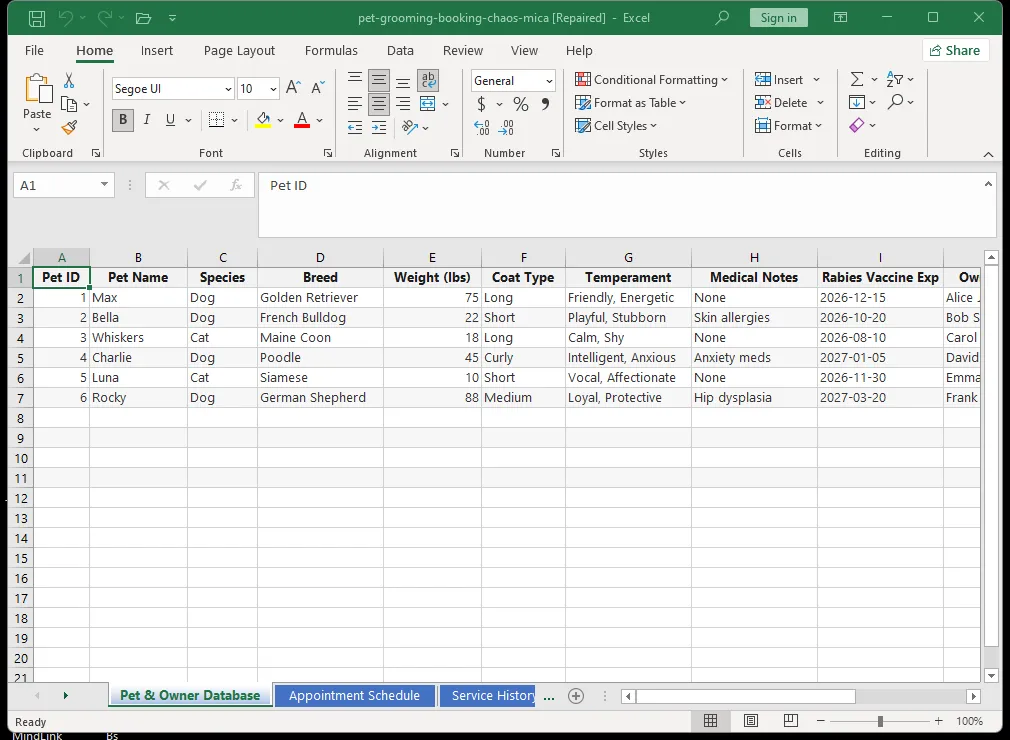
"Build me a weekly grooming schedule with 30-minute time slots from 8 AM to 6 PM. Each appointment should show client name, pet name, breed, service type, duration, and price. Color-code by service type. Highlight overlapping appointments in red. Add a second sheet that tracks client history including last visit date, total spent, and notes about the pet's behavior or medical conditions. Add a third sheet for daily revenue tracking."
Mica built the complete workbook in about 30 seconds. Jake reviewed it, made a few adjustments, and started using it the same day.
How the System Prevents Double-Bookings
The most important feature is the conditional formatting rule for overlaps. When Jake enters an appointment that conflicts with an existing booking, the overlapping cells turn bright red. He cannot miss it. The system does not allow him to accidentally take two appointments for the same time slot. In the three months since he started using Mica, he has had zero double-bookings.
Client History at a Glance
The second sheet consolidates everything Jake needs to know about each client. Before a groom, he glances at the history: last visit date, services performed, and behavioral notes. "Bella is nervous around the dryer." "Max has a sensitive spot on his left hip." "Owner prefers unscented shampoo." These notes save time during the appointment and make clients feel remembered. Jake reports that clients frequently comment on how well he remembers their pets, not realizing that his secret is a simple spreadsheet.
Revenue Tracking That Works
The third sheet calculates daily and weekly revenue automatically. Jake can see at a glance whether he is on track for his monthly target. He set a goal of $8,000 per month in grooming revenue. The dashboard shows his progress in real time. In the past, he only knew whether he had a good month when he added up his payments at the end. Now he knows on any given day whether he needs to push for more bookings.
The 10-Minute Morning Routine
Before Mica, Jake's morning routine was a multi-step scramble:
- Check the paper calendar for the day's appointments (5 minutes)
- Scroll through phone notes for any changes made after the calendar was updated (5 minutes)
- Cross-reference text messages from clients who booked or rescheduled the previous evening (10 minutes)
- Call or text each client to confirm the appointment (20 minutes)
- Plan the driving route based on the appointment locations (10 minutes)
- Hope that nothing changed while he was driving to the first client
Total morning admin time: approximately 50 minutes. That is nearly an hour of unpaid work before the first dog gets groomed.
Now Jake's morning looks like this:
- Open the Mica schedule on his phone. All updates from the previous day are already entered.
- Review the day's appointments in route order. The color-coded blocks show him exactly where he needs to go.
- Load the van and go.
It takes less than 10 minutes. And he never arrives at a double-booked slot.
The Measurable Results
After three months with Mica's scheduling system, Jake tracked the following results:
- Zero double-bookings — down from an average of 2 to 3 per month. A 100 percent elimination of the problem that cost him his most painful client loss.
- Customer scheduling complaints dropped to zero — clients stopped calling to confirm whether Jake had their time right.
- Revenue per week increased 18 percent — here is why: before Mica, Jake had gaps in his schedule that he did not notice until it was too late to fill them. Now, when a slot opens up, he sees it immediately and can offer it to a client on the waitlist. Those same-day fills added an average of $140 per week to his revenue.
- Client retention improved measurably — the consistent scheduling made clients feel taken care of. Jake noticed that his cancellation rate dropped from about 12 percent to 4 percent over three months.
- Jake takes Sundays off — for the first time since starting his business, he does not spend Sunday afternoon catching up on paperwork and rescheduling appointments.
The Financial Picture
The math is straightforward. Before Mica, Jake was losing roughly $300 per month to scheduling-related issues: the double-booking that cost him a client, the gaps that went unfilled, the cancellations he forgot to backfill. After Mica, those losses dropped to near zero. The system paid for itself — which cost nothing — on the first day.
The additional $560 per month from same-day gap fills and improved retention represents a meaningful increase for a solo operator. Over a year, that is $6,720 in additional revenue. All from a scheduling system that took 30 seconds to build.
How Any Groomer Can Build the Same System
You do not need Jake's specific setup to benefit from this approach. Mobile and brick-and-mortar groomers alike can use the same method. Here is a prompt you can adapt for your business:
"Create a grooming appointment scheduler with 15-minute time slots from 8 AM to 5 PM. Include client name, pet name, breed, service type, duration, price, and notes. Color-code by service type. Flag any overlapping appointments. Add a client history sheet with last visit, total spent, and pet notes. Add a revenue summary sheet."
Modify the time slot interval, service hours, and sheet names to match your operation. The system will be ready in less than a minute, and your data stays on your own computer.
Related Articles
Stop wrestling with spreadsheets. Let Mica build them for you.
Try Mica Free