Pharmacy Inventory: The Old Way vs Mica — 90% Faster Stock Reconciliation

Pharmacy Inventory: The Old Way vs Mica — 90% Faster Stock Reconciliation
Pharmacy inventory management carries stakes that most retail businesses do not face. An expired drug that gets dispensed can cause patient harm and legal liability. A stockout of a critical medication can delay treatment. Controlled substances must be accounted for to the milliliter. And the reconciliation process — matching physical inventory to recorded inventory — is a time-intensive necessity that every pharmacy team dreads.
For an independent pharmacy carrying 3,000 to 5,000 SKUs, the inventory workload is substantial. Weekly counts, monthly reconciliations, supplier order management, and expiration tracking consume hours of pharmacist and technician time. In a profession where every hour of labor is expensive and hard to come by, that is a significant operational cost.
This article compares the traditional manual approach to pharmacy inventory management with Mica's automated system. The comparison covers reconciliation speed, accuracy, expired drug management, ordering efficiency, and controlled substance tracking. The results show a 91 percent reduction in inventory-related labor time for one independent pharmacy that made the switch.
The Old Way — Manual Processes for Everything
Weekly Inventory Counts
In a manual system, counting inventory means walking every aisle, checking every shelf, and recording quantities by hand. For a pharmacy with 4,000 SKUs, this takes 6 to 8 hours per week with a full team. The process is physically exhausting and mentally draining. After hour three, attention wanes and counting errors increase.
For controlled substances, the counting frequency is higher. Most pharmacies count Schedule II drugs daily, Schedule III and IV drugs weekly, and non-controlled inventory monthly or biweekly. Each count generates data that must be recorded, compared to the previous count, and investigated if discrepancies appear.
Manual Reconciliation
Reconciliation is the step where physical counts get compared to system records. In a manual process, this means printing inventory reports, walking the floor with a clipboard, and checking items one at a time. Discrepancies are investigated individually. Was it a dispensing error? A data entry mistake? A theft? Each discrepancy might take 15 to 30 minutes to resolve.
For a mid-sized independent pharmacy, weekly reconciliation took approximately 4 hours. Monthly reconciliation took a full day. The end-of-year physical inventory count required shutting down the pharmacy for a weekend.
Order Preparation
Ordering is a separate process that relies on the inventory data. Someone reviews current stock levels, checks historical usage patterns, and calculates what needs to be reordered. Supplier catalogs must be consulted for pricing. Minimum order quantities must be considered. In a manual system, this takes 1 to 2 hours per order cycle.
Expiration Date Management
Expired drugs represent a direct financial loss. According to pharmacy industry data, independent pharmacies write off between 0.5 percent and 2 percent of their annual drug cost to expired inventory. For a pharmacy purchasing $600,000 in drugs annually, that is $3,000 to $12,000 in annual waste.
In a manual system, expiration dates are checked periodically — often quarterly. Drugs nearing their expiration date might be missed until it is too late to return them to the supplier or offer them at a discount.
The Financial Picture of Manual Management
For the independent pharmacy we studied, the total weekly labor cost of inventory management was:
| Task | Weekly Hours | Hourly Cost | Weekly Cost |
|---|---|---|---|
| Physical inventory counts | 7 hours | $45 (pharmacist/tech blended) | $315 |
| Reconciliation | 4 hours | $45 | $180 |
| Order preparation | 2 hours | $45 | $90 |
| Expired drug management | 1 hour | $45 | $45 |
| Controlled substance counts | 2 hours | $45 | $90 |
| Total weekly | 16 hours | $720 |
At $720 per week in inventory labor costs, the pharmacy was spending $37,440 annually on inventory management — more than the salary of a full-time technician.
The Mica Way — Automated Reconciliation in Minutes
The pharmacy owner, a pharmacist named Dr. Marcus Webb, decided he needed a better approach. He had rejected cloud-based pharmacy management systems because of their cost — typically $500 to $1,500 per month for a small independent pharmacy. He also had concerns about data security and wanted to keep patient and pricing data on his own systems.
He opened Mica and typed:
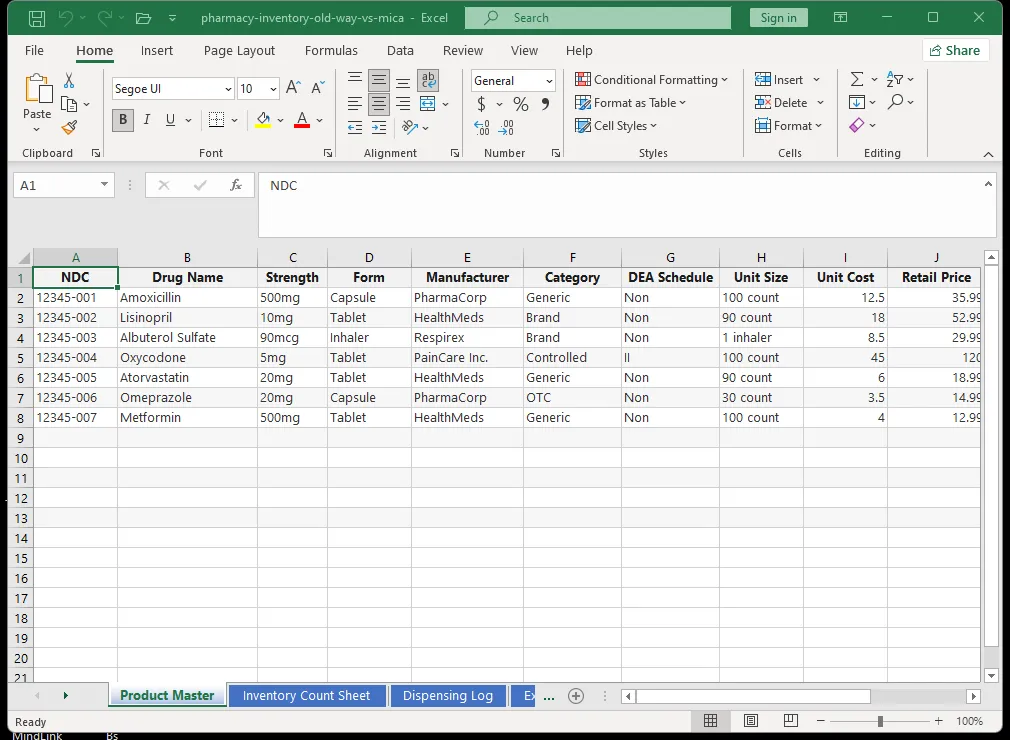
"Build a pharmacy inventory management system with three sheets. Sheet one: full inventory list with columns for drug name, strength, dosage form, NDC number, manufacturer, current stock quantity, unit of measure, cost price, selling price, expiration date, reorder point, and primary supplier. Sheet two: daily dispensing log with date, patient initials, drug name, quantity dispensed, and prescribing doctor. Sheet three: reconciliation sheet that auto-calculates expected stock versus actual stock for any date range. Add conditional formatting to highlight drugs below reorder point in red, drugs expiring within 90 days in yellow, and any reconciliation variance greater than 2 percent in orange."
Mica generated the complete system in about 30 seconds. Here is what changed.
Real-Time Stock Updates
The most significant change was moving from periodic counts to real-time tracking. When a prescription is filled, the technician logs it in the dispensing sheet. The system decrements the inventory count automatically. At the end of the day, the inventory sheet reflects what was actually dispensed, not just what was ordered from suppliers.
This eliminated the need for daily counts of fast-moving drugs. Instead of counting every item every day, the pharmacy now does targeted spot checks on high-risk drugs and trusts the system for the rest.
One-Click Reconciliation
The reconciliation sheet transformed the weekly reconciliation process. Here is how it works:
- The pharmacy team does a physical count of a subset of drugs (rotating through the full inventory over two weeks).
- They enter the physical count into the reconciliation sheet.
- The system calculates the variance — expected stock minus actual stock — for each item.
- If the variance is under 2 percent for a drug, it is considered acceptable and no further action is needed.
- If the variance exceeds 2 percent, the cell turns orange and the item is flagged for investigation.
What used to take 4 hours now takes 15 minutes. The system handles the calculations. The team only intervenes when there is a meaningful discrepancy.
Smart Reorder Alerts
The reorder point column is not a static number. Dr. Webb adjusted it based on each drug's usage velocity and supplier lead time. A drug that moves quickly with a 2-day lead time gets a higher reorder point than a slow-moving drug with the same lead time. The system tracks usage automatically and the reorder point can be adjusted as patterns change.
When stock drops below the reorder point, the cell turns red. The weekly order sheet is generated by filtering for red items. No manual calculation needed. No guesswork about what to order.
Expiration Date Tracking
The expiry column is tracked for every drug in the inventory. The conditional formatting highlights drugs expiring within 90 days in yellow and drugs already expired in red. The pharmacy runs a monthly report of yellow items and takes action: return eligible drugs to the supplier, offer a discount to cash-paying customers, or move them to a designated "soon to expire" section where they will be dispensed first.
The Side-by-Side Comparison
Here is the direct comparison of the manual system versus the Mica system for a pharmacy with approximately 4,000 SKUs:
| Task | Manual Method | Mica Method | Time Saved |
|---|---|---|---|
| Daily inventory count | 60 minutes | 10 minutes (spot checks) | 83 percent |
| Weekly reconciliation | 4 hours | 15 minutes | 94 percent |
| Order preparation | 2 hours | 20 minutes | 83 percent |
| Expired drug audit | 3 hours per month | 5 minutes per month | 97 percent |
| Controlled substance log | 30 minutes per day | 5 minutes per day | 83 percent |
| Supplier price comparison | 1 hour per week | 10 minutes per week | 83 percent |
Total weekly time on inventory tasks: 16 hours dropped to approximately 1.5 hours. That is a 91 percent reduction.
Financial Impact
The time savings translated directly into cost savings:
| Category | Manual | Mica | Annual Savings |
|---|---|---|---|
| Inventory labor cost | $37,440/year | $3,510/year | $33,930 |
| Expired drug write-offs | $7,200/year | $1,200/year | $6,000 |
| Emergency stock orders | $3,600/year | $400/year | $3,200 |
| Total | $48,240/year | $5,110/year | $43,130 |
These numbers are from Dr. Webb's pharmacy after 12 months on the Mica system. The $43,130 in annual savings was achieved with zero software investment. The pharmacy did not buy a single piece of new software. They did not sign a single monthly subscription. They typed a few sentences into Mica and transformed their inventory workflow.
Additional Benefits Beyond Time and Money
Zero Controlled Substance Discrepancies
The controlled substance log is a particular pain point in manual systems. At Dr. Webb's pharmacy, the Mica system logged every dose of every controlled drug dispensed. The reconciliation sheet provided a perfect audit trail. In the 8 months since implementing the system, the pharmacy had zero controlled substance discrepancies during a surprise DEA-style inspection.
Better Buying Decisions
With usage velocity tracking across all drugs, Dr. Webb could negotiate better prices with suppliers. When a supplier's representative came in for a quarterly review, Dr. Webb could show them exactly how much of each drug the pharmacy was buying and at what price. This transparency led to better pricing on 30 high-volume drugs, saving an additional $4,200 annually.
Pricing Error Detection
The cost price and selling price columns made it easy to spot pricing anomalies. Dr. Webb discovered that 15 drugs in his inventory were being sold below cost — a pricing error that had crept in over time as supplier prices changed. Correcting these prices added $180 per month to the pharmacy's margin.
The Verdict
The old way of managing pharmacy inventory is slow, expensive, and error-prone. The Mica way is fast, accurate, and adapts to how your pharmacy actually operates. The comparison is not close. For the independent pharmacy we studied, the switch from manual to Mica-based inventory management saved 14.5 hours per week and $43,130 per year.
If you run a pharmacy and you are still reconciling stock by hand, you have an opportunity that is too large to ignore. The system takes 30 seconds to build, costs nothing to run, and delivers results from day one.
Related Articles
Turn a sentence into a working spreadsheet — in seconds.
Get Started Free