3 Compliance Issues This Vet Clinic Avoided by Switching to Mica

Veterinary practices face increasing regulatory scrutiny across every state. Record-keeping failures are the single most common citation in state veterinary board inspections. Missing consent forms, incomplete controlled substance logs, and expired vaccination records consistently top the list of violations. The penalties are not theoretical. Fines range from $500 to $5,000 per violation. In severe cases, boards can suspend or revoke a clinic's license to practice.
For a small animal clinic in suburban Cleveland, Ohio, these risks were very real. The clinic had been using paper records since it opened in 2008. The system worked well enough day to day, but when the state veterinary board scheduled a surprise inspection, three separate compliance gaps were discovered. The clinic was not negligent. The team was dedicated and careful. They were using a paper-based system that made it nearly impossible to maintain consistent compliance over time.
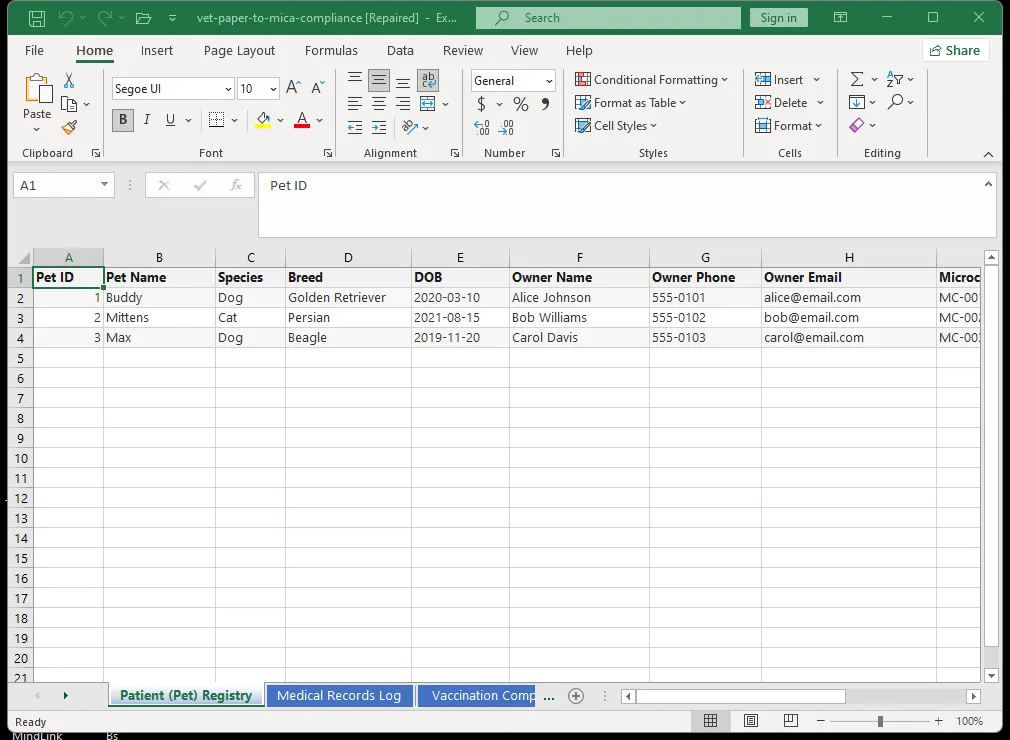
After the inspection, the clinic made a decision. Instead of investing thousands in a cloud-based practice management system with ongoing monthly fees, they built a Mica-based record-keeping system designed around the specific compliance requirements they needed to meet. Here are the three compliance issues they avoided — and exactly how Mica fixed each one.
Issue Number One — Incomplete Controlled Substance Logs
Controlled substances in veterinary practice include ketamine, acepromazine, tiletamine-zolazepam, and various narcotic analgesics. These drugs require meticulous tracking under federal and state regulations. Every dose dispensed or administered must be logged. The log must balance at the end of each month, meaning the recorded usage must match the physical inventory. An unbalanced log is not just a citation — it is a red flag that can trigger a deeper investigation.
The Paper Problem
The clinic's controlled substance log was a spiral notebook kept at the treatment station. When a veterinarian administered a controlled drug in an exam room, they would walk back to the treatment station and log it — sometimes immediately, sometimes at lunch, sometimes at the end of a busy day. By the time it was logged, details got fuzzy and handwriting got rushed. Was that 0.5 mL or 0.6 mL of ketamine? Did Dr. Williams or Dr. Chen administer that dose?
At month-end reconciliation, the log frequently failed to balance. The discrepancy was usually small — a milliliter or two — but any discrepancy is a compliance issue. The practice manager would spend hours retracing steps, questioning staff, and making educated guesses to get the log to balance. Sometimes the log was corrected. Sometimes it was left unbalanced. The state inspector found three months of unbalanced logs during the surprise visit.
How Mica Fixed It
The clinic manager opened Mica and typed:
"Create a controlled substance log with columns for date, time, drug name, concentration, lot number, amount used in milliliters, units, patient ID, administering veterinarian, and witness signature. Auto-calculate daily totals and monthly totals for each drug. Flag any daily discrepancy greater than 5 percent between the expected remaining quantity and the actual logged quantity. Add a reconciliation sheet that compares logged usage to physical inventory counts."
The Mica system changed the workflow in several ways:
Real-time entry is enforced. The log lives on a tablet mounted at the treatment station. Vets and technicians log each dose immediately after administration. The five-to-ten-minute delay between administration and logging is eliminated.
Auto-balancing catches problems early. At the end of each day, the system compares expected remaining stock to logged usage. If a discrepancy appears, it is flagged immediately — not discovered weeks later at month-end reconciliation. Small problems get resolved the same day.
The audit trail is complete. Every entry is timestamped and attributed to a specific veterinarian or technician. If an inspector asks about a particular dose on a particular date, the answer is a filter and a click away.
Month-end reconciliation takes 10 minutes. Instead of manually retracing entries, the practice manager opens the reconciliation sheet, enters the physical count, and the system calculates the variance instantly.
When the state board conducted a follow-up inspection six months later, the controlled substance log was the first thing they checked. It balanced perfectly for every month since the Mica system was implemented. The inspector noted that it was the cleanest controlled substance log she had seen outside of a corporate veterinary chain.
Issue Number Two — Missing Treatment Consent Forms
Informed consent is a legal requirement for any veterinary procedure. The consent form must document that the owner was informed about the risks, costs, alternatives, and expected outcomes of the proposed treatment — and that they agreed in writing. Missing or incomplete consent forms consistently rank among the top three citations in state veterinary board inspections.
The Paper Problem
At the Ohio clinic, consent forms were paper documents stapled to the inside of each patient's paper chart. In theory, every procedure had a signed form. In practice, forms went missing with alarming regularity. Charts were pulled for refiling and consent forms fell out. Kennels were cleaned and paper forms got wet and damaged. When records were digitized for insurance claims, the consent forms were often skipped because they were single-sided and stuck to the back of other papers.
The state inspector found that 12 of 60 randomly sampled patient records lacked signed consent forms for procedures that had clearly been performed. In some cases, the form existed but had been filed in the wrong chart. In other cases, the form was simply missing. The clinic was cited for inadequate consent documentation.
How Mica Fixed It
The clinic built a consent tracking sheet with Mica:
"Create a consent form database with patient name, owner name, procedure performed, date of procedure, risks discussed, cost estimate provided, consent method (signed form or verbal with witness), staff witness name, and the file location of the signed document. Add a column for consent status: complete, pending, or missing. Create a rule that any procedure scheduled on the appointment log must have a corresponding consent record before the appointment status can be changed to 'in exam room.'"
The new workflow transformed consent management:
Prospective enforcement. Before a procedure can begin, the consent status must be set to "complete." If the system shows "pending" or "missing," the front desk gets an alert. No procedure proceeds without documented consent.
Centralized database. All consent records live in one sheet, not scattered across individual paper charts. A search by patient name or date returns every consent form associated with that patient.
Audit-ready reporting. When the inspector asks for consent records, the clinic filters by date range and exports the sheet. Every procedure, every consent status, and every staff witness is documented in a single view.
Cost estimate documentation. The column for cost estimate provided addresses a specific requirement in many state regulations: the owner must be informed of the financial implications of treatment before consenting. The sheet documents that this conversation happened.
Issue Number Three — Expired Rabies Vaccinations on Record
Practicing veterinary medicine on a patient with an expired rabies vaccination is a compliance violation in most states. The regulation exists because rabies is a public health risk. When a clinic cannot produce valid rabies vaccination documentation for a patient they have treated, they face fines, mandatory retraining, and in some cases, reporting requirements to public health authorities.
The Paper Problem
At the Ohio clinic, rabies vaccination records were stored in the patient's paper chart. Staff were supposed to check the vaccination status at every check-in. In a busy practice with 35 to 45 patients per day, this check was frequently forgotten or rushed. A patient would be examined, treated, and discharged. Only later would someone notice that the rabies vaccine had expired three months ago. By then, the procedure had already been performed without valid vaccination documentation.
The inspector found seven patients in the sampled records who had been treated with expired rabies vaccinations on file. The clinic was cited and required to submit a corrective action plan.
How Mica Fixed It
The clinic asked Mica to add vaccination tracking to the existing patient records sheet:
"Add vaccination tracking to each patient record. For each vaccine type (rabies, DHPP, bordetella, leptospirosis, feline FVRCP), include columns for date administered, next due date, lot number, and manufacturer. Use conditional formatting to highlight any patient whose rabies vaccine is expired in red and any patient due within 30 days in yellow. Display a vaccination status alert on the appointment log dashboard that appears when an expiring or expired patient checks in."
The system changed the check-in workflow:
Automatic alerts at check-in. When a client checks in, the appointment log shows the patient's vaccination status in a dedicated column. If the rabies vaccine is expired, the cell is red. If it is due within 30 days, the cell is yellow. The front desk cannot miss it.
Opportunity capture, not just compliance. The clinic found that 40 percent of owners whose pets had expiring vaccines chose to vaccinate during the visit when prompted. What started as a compliance fix turned into a revenue opportunity. The clinic averaged $320 per month in additional vaccine revenue from owners who would have left without being reminded.
No more manual checks. The system eliminated the need for staff to flip through paper charts looking for vaccination dates. The information is visible on the dashboard before the owner finishes checking in.
The Lesson — Compliance Is a System Problem, Not a People Problem
The clinic manager shared a perspective that stuck with me. "We were not bad at record-keeping," she said. "We were using a system that made good record-keeping impossible. Paper degrades. Handwriting is subjective. Busy people forget. Mica did not add work to our day — it made the right thing the easy thing."
The total cost of implementing the Mica system was zero dollars in software fees. The cost of a single compliance citation would have been $500 to $2,000 per violation. With three violations found in the inspection, the potential liability was $1,500 to $6,000 in fines, plus the hidden costs of corrective action plans, follow-up inspections, and staff time spent addressing the citations.
The clinic's investment was the time it took to type a few prompts into Mica. The return on that investment was instant and ongoing.
Related Articles
Ready to let Mica handle your Excel chores?
Download for Free