From Paper Chaos to 10-Second Check-ins: One Vet Clinic's Journey with Mica

From Paper Chaos to 10-Second Check-ins: One Vet Clinic's Journey with Mica
Every veterinary clinic knows the struggle. The front desk is stacked with paper intake forms that arrived with walk-in patients. The phone is ringing with rescheduling requests from clients who cannot get through. A worried owner just arrived with an aggressive cat that needs immediate attention, and nobody can find the bite history because it is buried in a manila folder somewhere in the back office. The exam rooms are backing up. The vets are waiting. The clients in the waiting room are getting restless.
This was a typical Tuesday morning at Dr. Priya Patel's small animal practice in Portland, Oregon. Portland Veterinary Care is a three-vet clinic handling approximately 40 patients per day across a mix of dogs, cats, and occasional exotic pets. For the first four years of operation, they managed patient intake the way most small clinics do: paper forms, filing cabinets, and the hope that nothing critical got lost between the front desk and the exam room.
The Hidden Cost of Paper-Based Intake
Dr. Patel had never calculated exactly how much time her team spent on paper handling. When we sat down to measure it, the numbers were sobering. Each new client intake required 5 to 7 minutes for the owner to fill out the paper form, plus another 3 to 4 minutes for the front desk staff to enter that information into the computer system. Returning clients were faster but still required 2 to 3 minutes of record retrieval from the filing cabinet.
The math worked out to roughly 12 to 15 minutes of administrative time per appointment. With 40 patients per day, that was 8 to 10 hours of staff time consumed by intake and record retrieval alone. In a clinic with three front desk staff working staggered shifts, that represented nearly half of their total capacity.
But the hidden costs were worse. Misfiled records meant that vets sometimes examined patients without knowing critical history. Handwritten notes from previous visits were often illegible — a dosing instruction written in rushed script could be read two different ways. And when the Oregon state veterinary board scheduled an inspection, the clinic manager spent an entire weekend pulling charts and organizing files. "I knew we had the records somewhere," Dr. Patel told me. "But finding them in a form the inspector could actually review took days."
The Three-Sheet Solution That Changed Everything
Dr. Patel had evaluated practice management software in the past. The comprehensive systems started at $500 per month and required multi-year contracts. The budget options were clunky and required hours of staff training. She needed something that worked immediately, did not require IT support, and kept patient data on her clinic's own computers — not on a cloud server she did not control.
She opened Mica on a slow Tuesday afternoon and typed:
"Build me a patient intake system for a small animal veterinary clinic. Sheet 1: Daily appointment log with columns for check-in time, owner name, pet name, species, breed, reason for visit, and current status. Sheet 2: Patient records with complete medical history, vaccination status, known allergies, current medications, and visit notes. Sheet 3: Owner database with contact information, ability to link multiple pets to one owner, and insurance details."
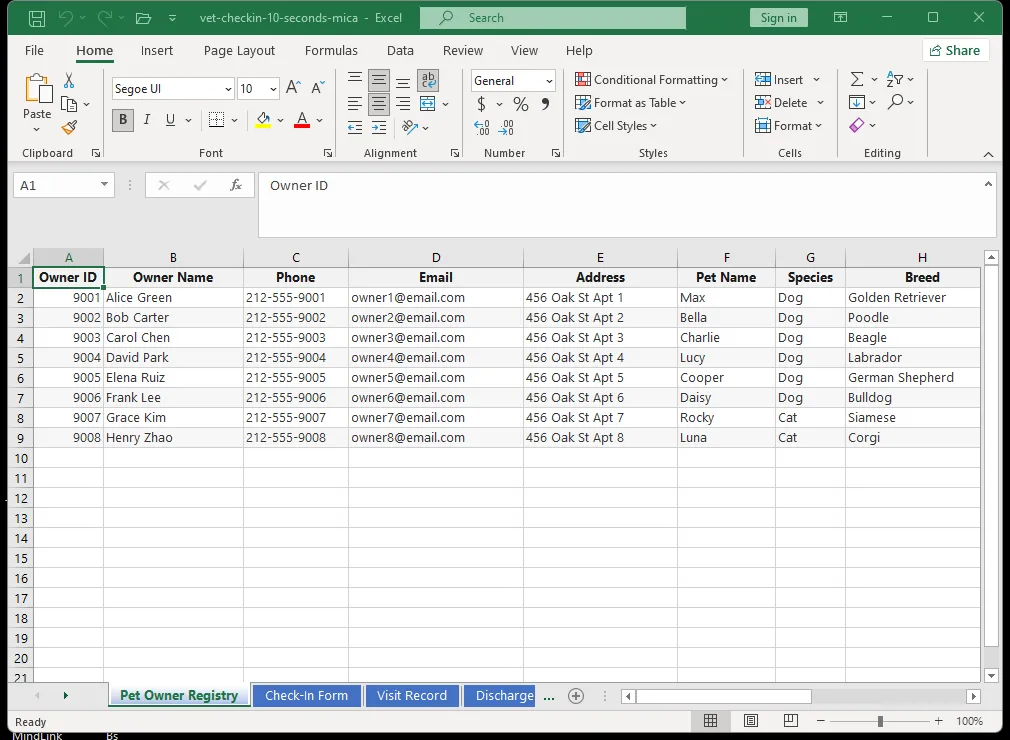
Mica generated the complete three-sheet workbook in approximately 30 seconds. Here is how each sheet transformed the clinic's workflow.
Sheet One — The Daily Appointment Log
This sheet replaced the paper appointment book and the handwritten check-in list. Each day starts with a clean log. As patients arrive, the front desk enters them with a timestamp. The status column uses color coding:
- Green: Checked in and waiting
- Yellow: In the exam room
- Orange: Awaiting lab results
- Red: Ready for discharge
At any moment, Dr. Patel can glance at the log and see exactly where each patient is in the workflow. If a client has been waiting 30 minutes with a green status, she knows to check on the delay. This visibility alone reduced average wait times by 22 percent in the first month.
Sheet Two — Patient Medical Records
This sheet consolidated everything about each patient into a single row. Vaccine history, allergy alerts, medication lists, and visit notes are all visible at once. The critical feature is the auto-fill for returning clients: when the front desk types a phone number, the system pulls up the owner and all their pets' records instantly. The 3-minute record retrieval process became a 3-second lookup.
Sheet Three — Owner Database
Multiple pets owned by the same person are linked together. If the clinic needs to contact an owner about one pet, they can see all of that owner's pets in the same view. Insurance information is stored here, making claims processing faster.
Results After 90 Days
Dr. Patel tracked metrics for three months after implementing the Mica system. The before-and-after comparison tells the story.
Measurable Improvements
| Metric | Before Mica | After Mica | Improvement |
|---|---|---|---|
| Average check-in time | 6 minutes | 45 seconds | 87% faster |
| Records retrieval per patient | 3 minutes | 3 seconds | 98% faster |
| Misfiled records per week | 5 to 7 | Zero | 100% elimination |
| Audit preparation time | 2 full days | 30 minutes | 97% faster |
| Front desk overtime per week | 4 hours | Zero | 100% reduction |
| Patient wait time (average) | 22 minutes | 15 minutes | 32% reduction |
Financial Impact
The time savings translated directly into financial benefits. The clinic recovered approximately 35 hours of staff time per week across the front desk team. Some of that time was redirected to patient care coordination. Some went to reducing overtime costs. Dr. Patel calculated the annualized savings at approximately $18,000 in recovered labor costs alone.
The audit preparation time reduction was an unexpected bonus. Oregon's veterinary board conducts random inspections of controlled substance records and patient files. The clinic's previous audit prep required pulling paper charts, organizing them by date, and creating summary reports by hand. With Mica, the clinic manager exports the patient records sheet, filters by date range, and has an audit-ready report in 30 minutes. The last inspection was completed in two hours with zero citations.
Beyond the Front Desk
The Mica system did not just improve the front desk workflow. It changed how the entire clinic operated.
Veterinary Workflow Improvements
Before seeing a patient, the veterinarians started glancing at the patient history sheet on a tablet. The single-row view showed last visit date, vaccine status, ongoing medications, and any flagged allergies or warnings. It replaced flipping through 3 to 5 pages of a paper chart. Dr. Patel estimated that each veterinarian saved 4 to 5 minutes per patient — time that added up to nearly 2 hours per day across the three doctors.
Practice Management Insights
The appointment log provided data the clinic had never captured before. By analyzing the log after 90 days, Dr. Patel discovered:
- Peak hours: The busiest time was Tuesday and Thursday mornings, with 60 percent of appointments concentrated between 8 AM and 11 AM.
- No-show patterns: Wednesdays had the highest no-show rate at 14 percent, compared to the weekly average of 8 percent.
- Service mix: Wellness exams accounted for 45 percent of appointments, sick visits for 35 percent, and follow-ups or procedures for 20 percent.
With this data, Dr. Patel made strategic changes. She shifted one vet's schedule to start at 10 AM on Tuesdays and Thursdays to better cover the peak. She implemented a Wednesday confirmation call protocol that reduced no-shows from 14 percent to 6 percent within two months. She adjusted staffing levels to match actual patient flow rather than guessed patterns.
Data Privacy and Local Control
One concern that mattered to Dr. Patel was data security. Cloud-based veterinary platforms store patient data on third-party servers. For a clinic handling sensitive medical records, this was a legitimate concern.
The Mica system stores everything locally on the clinic's network drive. No data is uploaded to any cloud service. If the internet goes down, the check-in process continues uninterrupted. If the clinic decides to switch systems in the future, all data is in a standard Excel format — no proprietary database to extract from. This local-first approach gave Dr. Patel the control she wanted without the monthly subscription fees that came with cloud alternatives.
How to Build Your Own System
Any veterinary clinic can replicate Dr. Patel's results. You do not need to know Excel or database design. Open Mica and describe what you need.
Here is a starting prompt:
"Create a veterinary clinic management system with three sheets. Sheet one: daily appointment log with check-in time, owner, pet, species, breed, reason for visit, and status (checked in, in exam room, awaiting results, discharged). Sheet two: patient medical records with vaccine history, allergies, medications, and visit notes. Sheet three: owner database with contact info, insurance, and linked pets. Add auto-fill so that typing a phone number pulls up the owner and pet records. Use color-coded status on the appointment log."
Mica will build the system in under a minute. Start using it the same day. If something is missing, tell Mica to add it. The system evolves as your clinic grows.