


WildFin is an AI financial-report product. Tam, DX, and Jessie built it at the FDE hackathon to turn dense, technical, and often boring financial reports into a live show people actually want to watch. It won the Best Popularity Award.
In WildFin, a financial report is not a table to decode line by line. It is a financial broadcast that runs from 00 to 09: gross margin, net margin, cash flow, leverage, and ROE/ROA become a signal stream. Numbers carry emotion, risk has a color, and even the copy has a slightly unhinged rhythm.
The problem it solves is simple: the first barrier to a financial report is not speed. It is that nobody wants to look.
What WildFin Is: An AI Financial Report That Feels Like a Live Show
WildFin turns financial-report reading into a live show you can watch and follow.
Open WildFin and the first thing you see is not a grid of cells but a dark broadcast interface: liquid-metal backgrounds, waveforms, data rain, a ticker, terminal labels, and a line on the page that says NO SAFE MODE. The site runs from 00 editorial to 09 risk notes, like a show that opens, builds, and lands.
Below is the motion piece from the WildFin homepage.
It turns gross margin, net margin, cash flow, leverage, ROE/ROA, and peer comparison into a scrollable signal stream. It even gives the company a 91/100 OVERDRIVE score.
So it is not a flashier dashboard. It is a paced narrative. The numbers are the same numbers, but they have expression, tone, and emotion.
Why WildFin: The Problem Is Not Speed, It Is That Nobody Wants to Look
WildFin did not start with “build another financial tool.” It started with a more basic question: why do most people look at a financial report and immediately think, “never mind”?
Financial reports are technical, dense, and full of jargon. Gross margin, net margin, liquidity, leverage, cash flow — every metric matters, but together they become a wall. For someone who does not read reports for a living, the first reaction is not “let me analyze this.” It is “I don’t get it.”
Many AI tools are solving the “calculate faster” problem. That matters, but the first barrier is not speed; it is that nobody wants to look. If the user leaves on the first screen, accuracy, completeness, and export options do not matter. This is the shift we discussed in From Chatbots to Action-bots: AI is moving from answering questions to executing and presenting.
WildFin reverses the order: make people stop first, then help them understand.
It does not reduce a report to a few big numbers. It turns numbers into signals with emotion. Gains are bright, risk is sharp, anomalies are amplified, and an absurd line of copy holds you in front of the screen for two more seconds. You are pulled in first; then you are willing to read.
Tam, DX, and Jessie: How Three People Built WildFin
WildFin was made by Tam, DX, and Jessie. The three did not work as an assembly line; they put their disciplines on the same table and let each discipline sharpen the other two.
DX studied directing in the Film and Television department at the Academy of Art University in San Francisco and worked as a still photographer on graduate crews. After returning to China, he founded OrdinaryIllusion (平凡·幻象), a visual design practice covering VJ, motion graphics, stylized photography, and creative advertising. WildFin started from a set of past works and materials he brought in. Tam connected those materials to the subject of financial reports, and the idea of WildFin appeared. DX then led the visual design and defined WildFin’s visual language.
Jessie is the founder of the OurAI community. She was responsible for finding WildFin’s use cases and product value: who would open it, in what situation, and what they could do afterward. She also brought real feedback from the OurAI community, so WildFin became more than a visual experiment; it became a product with a clear user and use case.
Tam led the AI technology and financial-domain judgment, and turned the idea into something that could be demonstrated. MINDLINK’s existing project resources were the base; Mica was the fastest workbench in the process.
DX and OrdinaryIllusion: Turning a Report into a Live Set
DX defined WildFin’s visual language. She works as a director and VJ; OrdinaryIllusion has always tied images, rhythm, and live emotion together, and her photography has appeared in Vogue Italia. You can see DX’s work and project record.
She does not look at WildFin as a layout first. She looks at how the show opens, when it should explode, and when it should pull back. A VJ does not “add effects” to a page; a VJ controls the emotional tempo of a live set. WildFin’s scrolling, letter spacing, motion, and liquid visuals are built layer by layer in CSS and graphics code; it is not a template, and it is not a static image pasted onto a page.
The visuals are not decoration. They make the numbers express emotion. As we wrote in the Excel formatting piece, formatting is not decoration; it decides whether people are willing to read. WildFin pushes that idea further: the report’s “format” becomes part of the narrative.
Jessie and the OurAI Community: Where Product Value Comes From
Jessie found WildFin’s product value. She is the founder of the OurAI community, and her daily work is about people: what they need, and when they need it.
She did not ask, “does this page look cool?” She asked: who will open WildFin? What problem are they trying to solve at that moment? After they read it, can they make a better judgment? Those questions made WildFin not just good-looking, but useful.
At the event, the first early users were already trying it next to us. Someone was pulled in by the visuals; someone asked, “What the hell are these ten male models? Your thing looks interesting”; someone else just said, “Holy shit, this is awesome.” That feedback made WildFin’s product direction more concrete.
OpenDev Judges and Feedback: AI, Insight, and Financing Trends
OpenDev supported the event and had members on the judging panel. During the event, they came to learn about WildFin and talked with us about the current state of AI, some industry insights, and financing trends.
The conversation moved from the product to the bigger picture: where AI tools are now, which products only look smart, which ones can actually change how people work, and how the capital market is looking at AI applications. Those questions made us realize that WildFin cannot stop at “good-looking.” It has to answer why it deserves to exist.
The FDE Hackathon: TuringArk, Shenzhou, and the Best Popularity Award
TuringArk put together the FDE hackathon. In Shenzhou’s space, tables were pushed together, laptops, power strips, and takeout boxes quickly covered every surface, and teams claimed their own corners. The room was full of conversations about models, tools, and products.
Before judging even started, people from the next table came over. Staff passing by stopped to ask what it was.
When it was our turn, the WildFin page opened and the room reacted immediately. Not polite applause — the kind of reaction that says, “Wait, what is this?”
WildFin won first place for the Best Popularity Award.
The award proved one thing: attention can be designed. In an information-overloaded environment, attention is a scarce resource. A financial report no one wants to look at is useless, no matter how accurate it is.
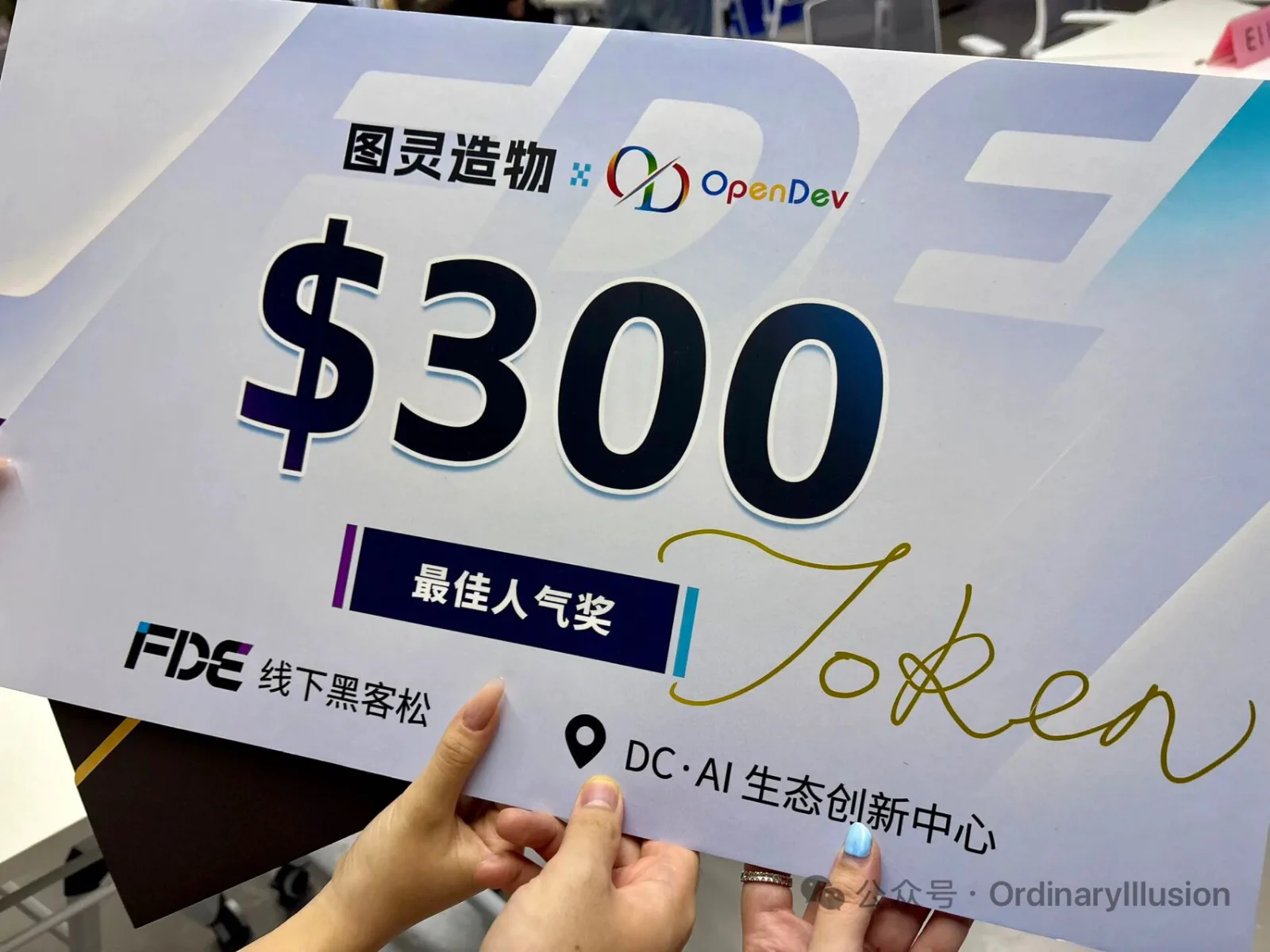
WildFin won first place in the Best Popularity Award; the prize was $300 in tokens.
WildFin’s Product Philosophy: Attention First, Understanding Second
WildFin’s product logic is not “calculate faster.” It is “make people willing to look first.”
WildFin breaks financial-report reading into three moves:
- Stop first. Visuals, pacing, and a slightly unhinged line of copy earn the first look.
- Then understand. Gross margin, net margin, cash flow, leverage, and ROE/ROA become signals with emotion, not a wall of jargon.
- Then judge. People without a finance background can form their own view instead of memorizing a few numbers.
Each team had only two minutes to present. A judge asked: the visuals are strong, but will users get visually tired if they look at it for a long time? Our answer was that WildFin would build a feedback loop and keep updating and improving. The important thing about a product is not how perfect it looks the first time, but whether it can keep listening and evolving.
That is also WildFin’s product principle: not another dull, cost-cutting AI tool, but a way to make complex things feel approachable again through visuals, copy, and narrative.
Speeding up a boring process does not make boredom disappear. WildFin wants to make a financial report worth looking at first, and something you can analyze second.
| Conventional financial tools | WildFin |
|---|---|
| Start with accurate calculations | Start by making you stop |
| Information density | Emotional density |
| Feature list | Sense of a live show |
| Cost reduction | Attention and understanding |
Mica’s Role in WildFin
Mica is one of MINDLINK’s project resources and the workbench behind WildFin’s creation.
Mica was originally built to help people work with Excel. In this project, it was not used to make a faster spreadsheet; it was used to quickly build a narrative about financial reports. It shortened the distance between an idea and a page: copy, structure, and repeated edits could move forward in the same context. If you want to know how Mica works, see What Is a Workbook Agent and How Mica Works.
But the final call on “does this line stay, does this motion pull back, does this screen need another pass” was still made by people. AI can help you build faster, but it cannot decide what is worth looking at.
What Comes Next for WildFin
WildFin has already proved one thing: a financial report does not have to be a table. It can be a product experience you can watch, feel, and discuss.
The next step is to bring that experience into real financial-report reading: help people who do not know finance want to look first, then understand; help people who read reports every day feel less tired and make better judgments. It is not another flashier dashboard. It is a new way to read a financial report.
Frequently Asked Questions
What is WildFin?
WildFin is an AI product that turns financial reports into a live show, so people without a finance background can want to look first and then understand.
Who made WildFin?
Tam, DX, and Jessie created WildFin at the FDE hackathon. Tam led AI technology, financial-domain judgment, and product structure; DX led visual design; Jessie led use cases and product value.
Why does WildFin use such strong visuals?
Because the first barrier to a financial report is not speed; it is that nobody wants to look. WildFin uses visuals and narrative to catch attention first, then bring users into the numbers and the judgment.
What did Mica do in WildFin?
Mica was the workbench: it helped the team move ideas, copy, structure, and repeated page edits forward quickly. Aesthetic judgment and product decisions stayed with the people.
Is WildFin available now?
WildFin is an early version. To learn more or discuss collaboration, contact tam@mindlink.tools.