

The cap table is the model
Five financing rounds, one rule: every post-money cap table closes to 100%. Six checks, one per table, catch double-counted option pools, percentages added instead of multiplied, and a conversion at the wrong price.
A fund's return depends on how much of each company it owns when the company exits. That ownership is the product of every financing round, and each round dilutes everyone who did not participate.
The workbook models five rounds across four companies and produces six cap tables. Six checks cover those tables, and every one of them is the same assertion: the holders sum to 100%.
Why the 100% Sum Is the Check
Every holder's stake has to sum to 100% because the round divides the post-money equity completely.
A cap table is a partition. Existing holders, the new investor, an option pool: they divide the post-money equity completely, with no gaps and no overlaps.
Six ways to break the partition, all common:
The option pool is double-counted. A pool created pre-money dilutes founders; one created post-money dilutes everyone including the new investor. Including it twice produces a table that sums to more than 100%.
A round is applied to the wrong base. Dilution is multiplicative, not additive. A 20% round followed by a 20% round leaves founders with 64% of their original holding, not 60%. Adding percentages produces a table that sums correctly in the spreadsheet and is wrong in the cap table.
Convertible notes convert at the wrong price. A note with a discount and a cap converts at whichever is more favorable to the holder, and the resulting shares change every other percentage.
The pool top-up is missed. Many term sheets require the pool to be topped up to a fixed percentage post-money, which dilutes founders by more than the round alone implies.
The ESOP is counted at authorized rather than issued shares.
A round is entered as a new holder without reducing the existing ones.
Six checks, one per table, catch all of them: a table that does not sum to 100% is broken, whatever the cause.
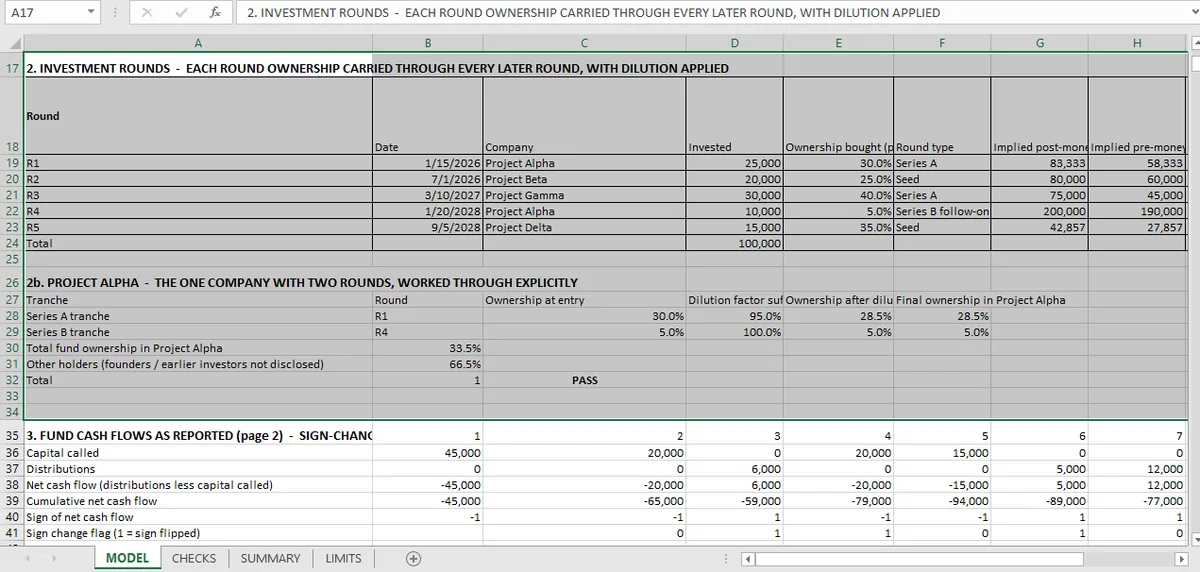
The dilution that matters for the fund
Project Alpha is held through an early round and then diluted at Series B. The fund's ownership percentage falls, and its proceeds at exit fall with it, unless it exercises its pro-rata rights, which the workbook models as a choice.
The check on the diluted tranche is the one that ties the cap table to the cash flow: the fund's ownership after the round has to be consistent with the proceeds it receives if the company exits at the modelled value. That exit value is the number a DCF walkthrough computes before the ownership stake is applied.
What the model does not cover
Liquidation preferences. The waterfall at exit is modeled at fund level, not company level. A 1× non-participating preference changes the split between common and preferred at low exit values, and the workbook does not model it per company.
Anti-dilution provisions. Full ratchet and weighted-average protections change the conversion price after a down round. Neither is modeled.
Pay-to-play and pro-rata mechanics. The fund's participation decision is modeled as a given, not as a strategic choice.
Those three are where real fund returns diverge from a naive cap table. The workbook's limits sheet does not claim them, and a reader should treat the ownership percentages as the arithmetic of dilution rather than a forecast of the fund's share.
One rule per round
Whatever the round structure, the post-money cap table sums to 100%. It is one formula, it is the first thing to put in any model that touches ownership, and it catches most of the errors that produce a fund return which cannot be reproduced.
The IRR article uses the proceeds these cap tables produce, and all 48 checks, with their cell references, are in the alternatives hub. The multiples these stakes produce are in the multiple identity, and the property analogue is in the property DCF.
Each holder's stake is written as a formula on the round in Mica, so a cap table that does not close fails immediately.