

Private equity IRR: a ten-year fund
The case. A ten-year private equity fund read from a two-page summary: 100,000 committed, five portfolio rounds across four companies, a distribution schedule, three scenarios (base, bull, bear) and a simplified waterfall with a preferred return and carry. Every input is constructed; there is no real fund, no vintage and no benchmark. This is a synthetic case for method demonstration, not investment, tax or legal advice.
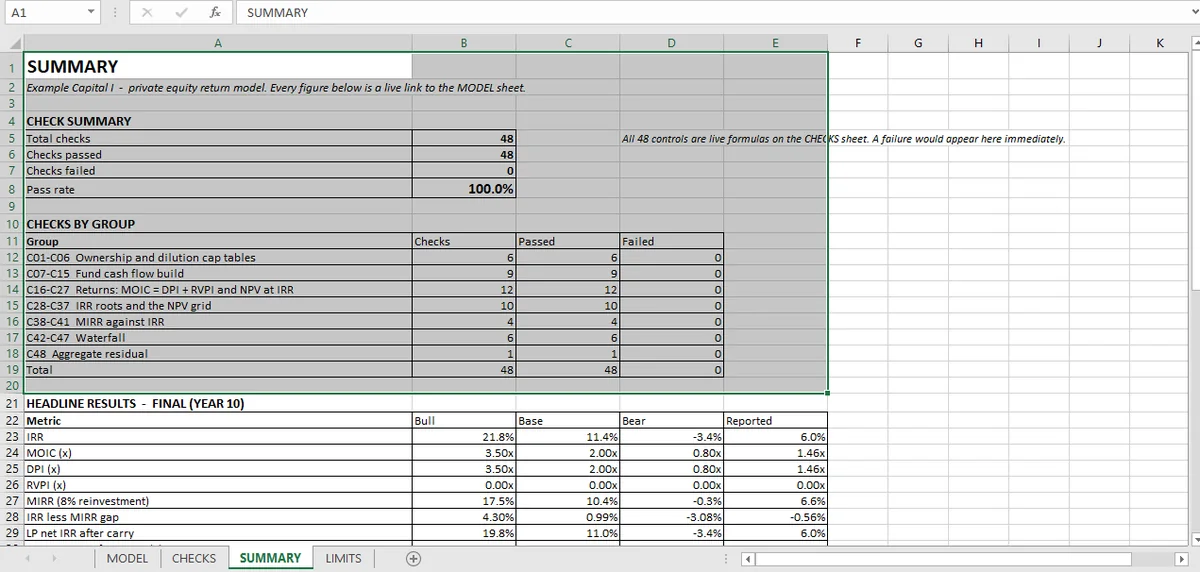
Reported IRR 6.03%, MOIC 1.46×, MIRR 6.59% at an 8% reinvestment rate. Forty-eight checks, including a second cash flow with two positive roots.
| Measure | Reported | Base | Bull | Bear |
|---|---|---|---|---|
| IRR | 6.03% | 11.37% | 21.76% | −3.39% |
| MOIC | 1.46× | 2.00× | 3.50× | 0.80× |
| DPI | 1.46× | 2.00× | 3.50× | 0.80× |
| RVPI | 0.00× | 0.00× | 0.00× | 0.00× |
| MIRR at 8% | 6.59% | 10.38% | 17.47% | −0.30% |
Forty-eight checks back the workbook. All pass.
The 48 checks prove the cash-flow arithmetic and the root count. The distribution schedule is the input; the waterfall tests the split of the cash flow it is given.
What forty-eight checks show
Seven groups, and the first one is the one that makes the rest meaningful. The check-writing mechanics are in the Excel-for-finance guide.
| Group | Checks | What it establishes |
|---|---|---|
| Cap tables | 6 | Fund and other holders sum to 100% after every round |
| Fund cash flow | 9 | Calls, distributions and net flow rebuild from their components |
| Returns | 12 | MOIC = DPI + RVPI in every scenario, with and without a live NAV |
| IRR roots | 10 | Sign changes, Descartes bound, NPV zero at each located root |
| MIRR | 4 | Sits between the IRR and the 8% reinvestment rate |
| Waterfall | 6 | Tiers add to the distributable amount; carry is the residual above the hurdle |
| Aggregate | 1 | MOIC less DPI less RVPI is zero across all scenarios |
The finding: one cash flow, two roots
The reported fund cash flow has three sign changes and exactly one positive IRR, 6.03%. The checks find the root three ways (a located root, an NPV grid, and Excel's IRR()), and they agree.
A second cash flow in the workbook has two sign changes and two positive roots: 6.10% and 163.9%.
That is the point of the topic. Excel's IRR() returns whichever root its starting guess reaches, and the workbook demonstrates it by computing both roots independently, checking the NPV is zero at each, and then comparing what IRR() returns. The function lands on one of them without telling you the other exists.
A fund with an IRR of 164% is not a fund; it is a cash flow that changes sign twice. The IRR article works through the case. The same IRR arithmetic appears in the capital appraisal.
The waterfall, and where the carry comes from
The distribution tiers are checked against the distributable amount: return of capital, preferred return, then GP carry on the residual above the hurdle.
In the base case the fund distributes 200,000 against 100,000 of paid-in capital: 80,751 of preferred return, 3,850 of GP carry, and the remaining 15,399 to the LP as its residual share. The tiers plus that residual sum to the distributable amount exactly, and the carry is checked against the carry rate applied to the residual rather than against a typed number.
The last check matters more than it looks. A carried interest computed as a percentage of the whole distribution, rather than of the residual above the hurdle, is the most common waterfall error. It overstates the GP's share by a large margin.
The rest of the fund series
The IRR roots is the cash flow with two correct answers. The multiple identity is MOIC against DPI and RVPI. Dilution is the cap table that has to close to 100%. The property DCF is an asset class this workbook does not model. Cap rate and leverage is the other half of that method. The integration article is how the 48 checks follow the cash flow.
What the fund model does not cover
Five limits, and the first two are structural.
No real estate. Two of the articles in this topic, cap rates and a property DCF, describe methods the workbook does not contain. The fund model is private equity, and the limits sheet says so; those articles are about what a property model would need. The cash-flow construction is worked through in the DCF walkthrough.
No market data. Every input is constructed: the rounds, the distribution profile, the scenario weights. Nothing here is calibrated to a real fund or a real index.
No gross-to-net reconciliation beyond carry. Management fees, fund expenses and a hurdle with a catch-up are represented in simplified form.
One fund, one vintage. No portfolio of funds, no J-curve (the early negative returns of a fund) comparison across vintages, no benchmarking against a quartile.
The IRR is one number for a ten-year cash flow. Duration, the timing of the cash flows, and the reinvestment assumption are all compressed into it.
Read plainly, the 48 checks establish the return arithmetic is right and that a multi-root cash flow is handled honestly. They say nothing about whether a 6.03% IRR is a good outcome for a fund of this risk.
The fund model sits in a single Mica workbook, which is what lets the cap tables, the cash flow and the waterfall read from the same inputs.
Frequently asked questions
Can a fund cash flow have more than one IRR?
Yes. IRR is a root of the cash-flow polynomial, and every sign change can add a root. The second series in this workbook has two positive roots, 6.10% and 163.9%, and Excel returns whichever one its guess reaches.
Why is IRR misleading for private equity?
IRR assumes interim cash flows are reinvested at the IRR itself, which flatters early distributions in a fund with a high interim rate. MOIC and DPI show how much cash was actually returned; MIRR restates the return at an explicit reinvestment rate. Here the reported IRR is 6.03%, MOIC is 1.46× and MIRR at 8% is 6.59%.
What is the difference between IRR, MOIC and DPI?
IRR is a money-weighted annual rate; MOIC is total value divided by invested capital; DPI is cash distributed divided by paid-in capital. They answer different questions, and a fund can look strong on one and weak on another.