

Three multiples that have to reconcile
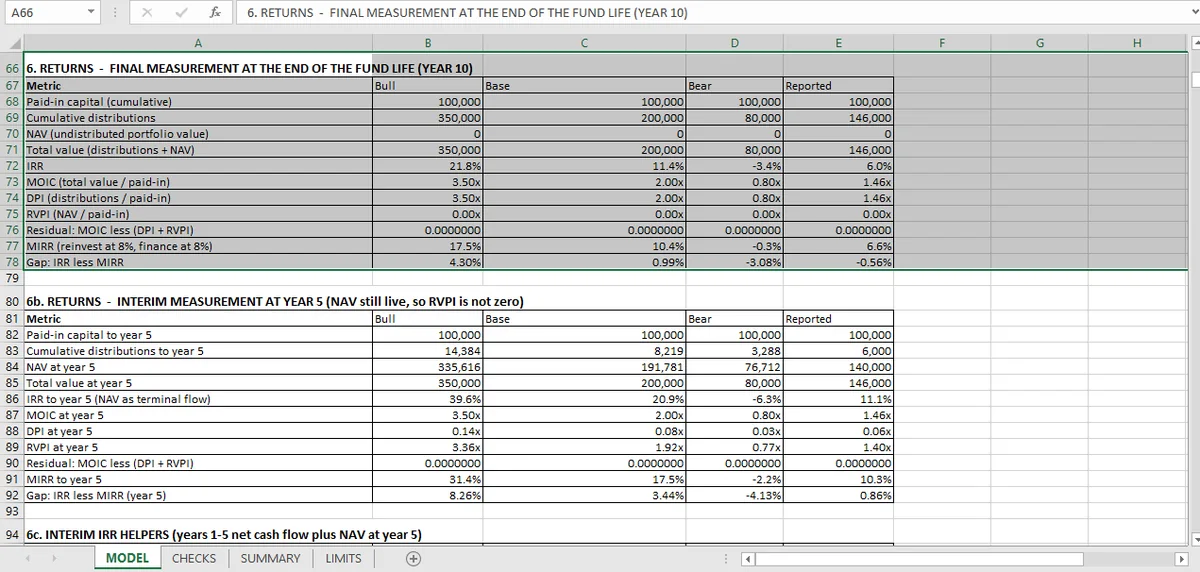
MOIC equals DPI plus RVPI, by definition. The workbook checks the identity in four scenarios and again with a live NAV, and the aggregate residual across all of them is zero.
Private equity reports returns as multiples as well as an IRR, because a multiple is cash-based and an IRR is timing-based.
- DPI: distributions to paid-in capital. Cash actually returned.
- RVPI: residual value to paid-in capital. What is still held, at its mark.
- MOIC: total value to paid-in capital.
The identity is simple:
It is also the check that catches the most common reporting error: a multiple that includes unrealized value in the DPI, or a total value to paid-in capital (TVPI) that is labeled MOIC.
The Four Multiple Scenarios
The workbook reports the multiple identity in four scenarios.
| Scenario | DPI | RVPI | MOIC |
|---|---|---|---|
| Bull | 3.50× | 0.00× | 3.50× |
| Base | 2.00× | 0.00× | 2.00× |
| Bear | 0.80× | 0.00× | 0.80× |
| Reported | 1.46× | 0.00× | 1.46× |
Twelve checks confirm the identity holds: three per scenario, with a live-NAV pass inside each set. With RVPI at zero, the identity is satisfied by construction; the live-NAV version is the one that tests addition, because a scenario where residual value is non-zero is the only one that exercises the sum.
The residual check at the end aggregates across all scenarios and both bases: MOIC less DPI less RVPI, across the board, is zero.
Why the MOIC = DPI + RVPI Identity Matters
The identity is the only check that forces the three numbers to be defined consistently.
A fund's reported multiple is often assembled from three different systems: the cash ledger for distributions, the valuation policy for residual value, and a spreadsheet for the total. If the identity does not hold, one of the three is wrong, and the reported MOIC is the one that gets quoted.
The check is cheap and it is the only thing that forces the three numbers to be defined consistently. A DPI that counts a return of capital twice will break it immediately.
MIRR, and why a fund reports both
The MIRR is 6.59% at an 8% reinvestment rate, against an IRR of 6.03%. Four checks confirm it sits between the IRR and 8%. The definition is the project-finance one set out in the project MIRR comparison, where MIRR is the stated-reinvestment alternative.
That is a narrow gap, and it is the useful thing about MIRR for a fund: when IRR and MIRR are close, the timing of the cash flows is not doing much work, and the return is close to what a simple compounding would produce. When they diverge, the IRR is being flattered by the reinvestment assumption.
For a ten-year fund with early distributions, that divergence can be large. Here it is small, because the distributions are back-loaded relative to the calls.
What multiples cannot tell you
Timing. A 2.0× over ten years and a 2.0× over five years are the same multiple and very different outcomes. That is what the IRR is for, and why both are reported.
Risk. A bear case of 0.80× and a bull case of 3.50× is a wide distribution. The multiple says nothing about which is more likely.
Mark quality. RVPI is a valuation, not a cash amount. A fund with a large RVPI has a large number that nobody has paid for yet.
The identity worth checking first
Anywhere three related quantities are reported, one of them is usually a residual. Check the identity, not the components: DPI and RVPI can each look plausible while their sum does not match the MOIC, and the sum is the number a reader will quote.
The IRR article covers the return measure that this identity does not constrain, and the complete 48-check sheet is in the alternatives hub. The ownership producing the distributions is in the cap tables, and the exit-value version is in the property DCF.
Distributions and residual value live in separate cells in the Mica build, which means the multiple identity is checked rather than assumed. Splitting them is the Excel model discipline that makes the identity testable.