
Option pricing: one term sheet, nine instruments
The case. One internal deal-sheet image listed seven options and two interest-rate swaps. The image supplied only contract terms: spot, strike, expiry, rate, volatility, dividend yield, notional and fixed rate. There is no market data feed and no external price. The engine prices the nine instruments off a flat 4.00% continuous curve, with one lognormal volatility per option and no smile. This is a synthetic case for method demonstration, not investment, tax or legal advice.
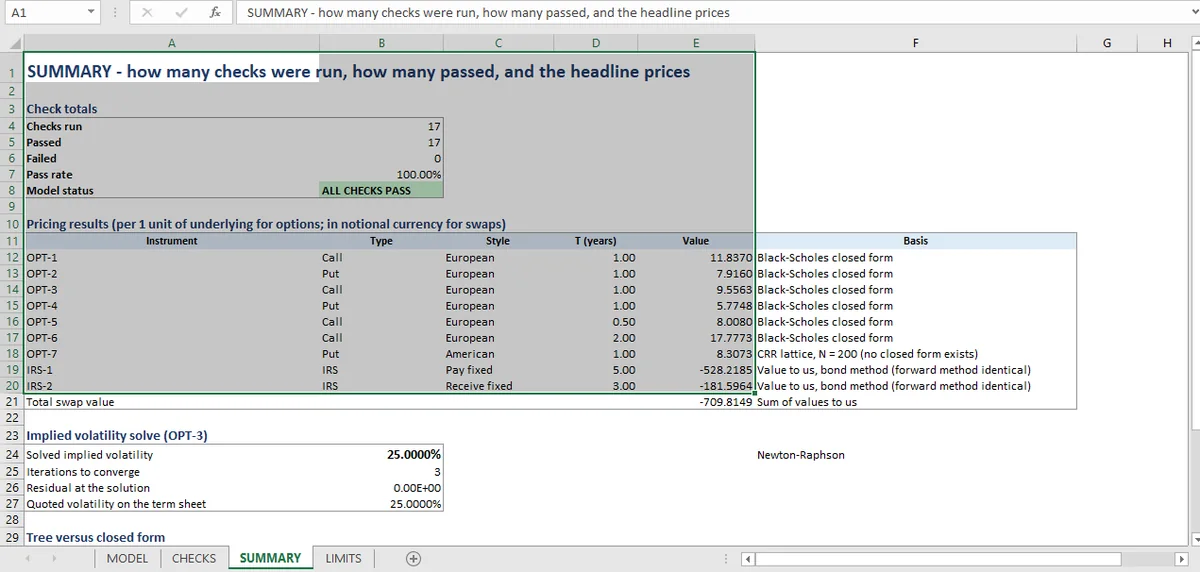
Seven options and two swaps were priced from a term-sheet image and passed 17 checks: put-call parity to 7×10⁻¹⁵, a lattice that converges to Black-Scholes, five Greeks against finite differences, and two methods for every swap. All 17 pass.
Nine instruments come out, priced from a flat 4.00% continuous curve:
| Instrument | Terms | Price |
|---|---|---|
| OPT-1 | Call, S=K=100, 1y, σ=25% | 11.837 |
| OPT-2 | Put, same terms | 7.916 |
| OPT-3 | Call, K=105 | 9.556 |
| OPT-4 | Put, K=95 | 5.775 |
| OPT-5 | Call, 6 months | 8.008 |
| OPT-6 | Call, 2 years, q=2%, σ=30% | 17.777 |
| OPT-7 | Put, American, 1y | 8.307 |
| IRS-1 | 5y, pay 4.20% fixed | −528.22 |
| IRS-2 | 3y, receive 3.95% fixed | −181.60 |
Seventeen checks back the workbook. All pass.
Sixteen of the 17 checks compare the model to itself; parity is the only one that does not. All 17 are conditional on the term sheet: they test the relationships among the inputs, not the inputs themselves.
What seventeen checks show
Seventeen is a small number, and that is the point of this topic. Each check is a different *kind* of evidence, and between them they cover the four ways a pricing model can be wrong. How the engine is written into the file is covered in the workbook-agent guide.
Parity (1 check). The call and the put on identical terms must satisfy put-call parity. The residual is 7.1 × 10⁻¹⁵: a number small enough to be rounding noise in double precision, and the strongest single check in the workbook because parity depends on the price but not on the model that produced it.
Lattice versus closed form (3 checks). The binomial tree is computed at six step counts and compared with Black-Scholes. At N=1000 the tree gives 11.8346 against 11.8370, a gap of 0.0025 or 0.02%, and the gap narrows at every step count.
Greeks (5 checks). Delta, gamma, vega, theta and rho are computed twice: once from the closed-form formulas, once by central finite difference. All five agree to better than 0.0001% of the analytic value.
Method agreement (4 checks). Each swap is valued two ways, by the bond method and by the forward-rate method, and the floating leg is checked to price at par. The two methods agree to machine precision.
Boundary and inversion (4 checks). The American value is at least the European value (it is 0.391 higher), the lattice has converged between N=100 and N=200, and the implied volatility solve recovers the 25% quoted on the term sheet after three iterations.
Beyond this engine
Forwards and the basis covers the one instrument this engine does not price. Two routes for every swap is the strongest structural check on the sheet. The closed form against the lattice and the convergence table cover the two pricing methods. Greeks by finite difference covers the five sensitivities. The implied volatility solve covers the one place an external price enters. The integration article explains why seventeen checks is not a small number.
For a worked build from assumptions rather than a deal sheet, the DCF walkthrough is the closest general example.
What this topic does not cover
The workbook is unusually direct about its own limits: twenty numbered entries, and the last one is the important one:
> None of the 17 checks is a test against an external price. A clean check sheet proves the arithmetic is self-consistent, not that the model is suitable for live risk.
That distinction is the whole argument of this section in one sentence. Parity, lattice convergence, finite differences and method agreement are all *internal* comparisons. These comparisons catch algebraic errors, wiring errors, and specification errors where two routes share the same wrong assumption; they cannot catch a wrong volatility, a wrong curve, or a convention that differs from the market.
Four limits matter for anyone reading the numbers:
The curve is flat. One 4.00% zero rate, no bootstrapped term structure, no separate projection curve, no overnight indexed swap (OIS) basis. Forward rates and both swap values are flat-curve values. The same flat-curve simplification is in the fixed-income workbook.
Volatility is a single number. One lognormal volatility per option, no smile, no term structure. Prices and Greeks are valid only at the quoted volatilities.
The American option is really Bermudan. Exercise is tested on 200 lattice nodes, which is 200 dates, not continuous. The value is biased marginally low.
There is no market data feed and no external validation. Every input is typed from the image. If an input is wrong, the model is wrong, and only internal consistency is tested.
Put-call parity: the one check to look at first
If you only read one row, read parity. It compares a call and a put on identical terms through a relationship that holds regardless of how either was priced, and the residual here is fourteen orders of magnitude below the price.
Everything else in the workbook, including the 17 checks, is a comparison between two things the same model computed. Parity is the closest thing to an independent test available without an external quote, and it is the reason the first article in this topic is about what the engine prices and what it does not.
The pricer Mica built from the deal sheet inside Excel lets every check be clicked through to the cell it reads.
Questions about the engine
How do you check a Black-Scholes price?
Test it against relationships that must hold independently: put-call parity, convergence of a binomial tree to the closed form, Greeks against finite differences, and an implied-volatility round trip. This engine runs 17 checks across those tests.
Does a binomial tree converge to Black-Scholes?
Yes, for a European option as the number of steps rises. Here the gap falls at every step count, from 0.243 at 10 steps to 0.0025 at 1,000.
Why do analytic Greeks differ from finite differences?
Analytic Greeks differentiate the formula; finite differences reprice the option after a small bump. They converge as the bump shrinks, but a badly chosen step size introduces error. Five Greeks in this workbook are checked against finite differences.
Is any check against a market price?
No. Every check is internal, and the limits sheet states that explicitly.