

Implied Volatility: Recovering the Volatility Behind a Price
The workbook recovers that volatility from the price.
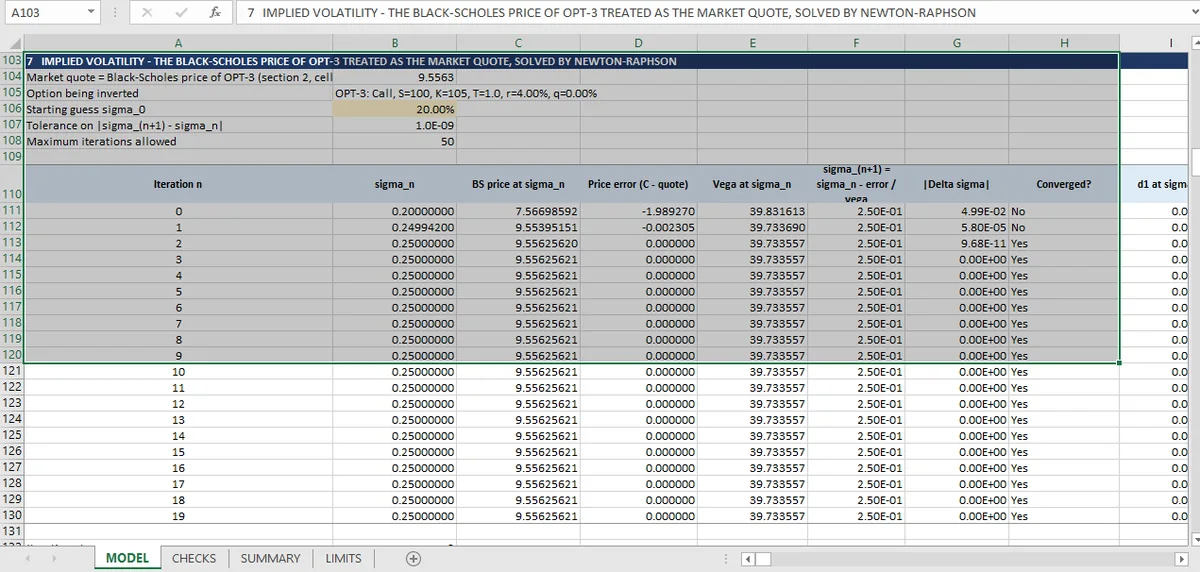
Implied volatility is the root of a price equation. Here a test price of 9.556 inverts to 25.00000000000002% in three Newton iterations with a residual of zero. There is no fallback if vega goes to zero or the quote sits outside the arbitrage bounds.
An option price depends on spot, strike, time, rate, dividend and volatility. Five of those are observable. Volatility is not. It is the input the market is implicitly agreeing on when it quotes a price.
Inverting the formula to recover it is a root-finding problem: find σ such that Black-Scholes(σ) equals the test price. The workbook does it with Newton-Raphson and checks the answer two ways.
The Newton-Raphson Solve
The workbook solves for volatility with Newton-Raphson.
The test price is 9.556256, generated by pricing OPT-3 at 25% volatility with Black-Scholes. Starting from a guess of 0.20, Newton iterates:
and converges to 0.2500000000000002 in three iterations, with a residual of zero at the solution.
Three iterations is what quadratic convergence looks like. Newton roughly doubles the number of correct digits each step, so starting 5 volatility points away and landing on 2 × 10⁻¹⁶ is not a coincidence. It is the method behaving as designed on a smooth, well-conditioned function. The bond workbook solves a different root in the yield solve, where the residual at the solved rate plays the same role.
The Two Checks on the Volatility Solver
Price reproduction. Take the solved volatility, price the option again, compare with the test price. Difference: 0 at 10⁻⁹ tolerance. This is the direct statement of what "implied" means.
Recovery of the quoted volatility. The solved value must equal the 25% that produced the market price. Difference: 2 × 10⁻¹⁶. This check is stronger than the first, because a solver could reproduce the price by hitting the wrong volatility on a flat region of the price curve; recovering the exact input rules that out.
Where the method breaks
Newton is fast when it works and uninformative when it does not. The limits sheet is unusually candid about the gaps:
> Newton-Raphson for implied volatility has no bisection fallback, no vega floor, no arbitrage-bound pre-check; convergence depends on the 0.20 starting guess.
Four failure modes, and each is worth knowing before trusting a solve.
Vega goes to zero. Deep out of the money or very short dated, vega approaches zero, and the Newton step divides by it. The price barely moves with volatility, so the inversion is ill-conditioned: a 1 unit price error corresponds to a large volatility error. At the solution here, vega is 38.3, so a 1 unit price error becomes 0.026 of volatility, or 2.6 points. For a far out-of-the-money option vega might be 0.5, and the same price error becomes 2.0 of volatility.
The price is outside the arbitrage bounds. If the quote is below intrinsic value or above the underlying, no volatility exists. Newton will still iterate, toward a negative or enormous number, and can converge to a wrong root that reproduces nothing.
The starting guess is far away. A guess of 0.20 against a true 80% volatility can diverge or oscillate. A bracket-based method, or a bisection fallback, is the standard remedy.
The surface is not flat. The workbook solves for a single volatility per option. On a real smile, a Newton solve against a Black-Scholes formula gets you the Black-Scholes implied volatility, which is a quoting convention rather than a statement about the distribution.
What a robust solver adds
Three things, ranked by cost.
A bracket check first. Compute the price at 1% and 500% volatility. If the test price is outside that range, stop and report: no root exists.
A bisection fallback. If Newton's step is outside the bracket or vega is below a floor, take a bisection step instead. It is slower and it always converges on a bracketed root.
A residual report. After solving, price the option again and state the difference. A solver that reports convergence without a residual has not shown anything.
The workbook does the third of those as a check, which is why the result is trustworthy for this input. It does not do the first two, and the limits sheet says so rather than leaving a reader to discover it.
What the Implied Volatility Check Validates
Every check in this workbook is a comparison between two things the model computed. The implied volatility solve is the one place where that structure does real work against an external number, the market price, even though the market price here is itself generated from the model at a known volatility.
That is the honest status of the check: it demonstrates that the inversion machinery works when the answer is known, which is the right way to test a solver before pointing it at a live quote. The Greeks article covers the vega that the Newton step depends on, the closed form it inverts is in the Black-Scholes article, the lattice that prices the options without one is in the convergence article, and the complete check sheet is in the derivatives hub.
The starting guess and the iteration count are cells in the Mica build, which makes the solve reproducible rather than a black box. Reproducibility of that kind is the workbook standard the rest of the series applies.