

A tree is only useful if it converges
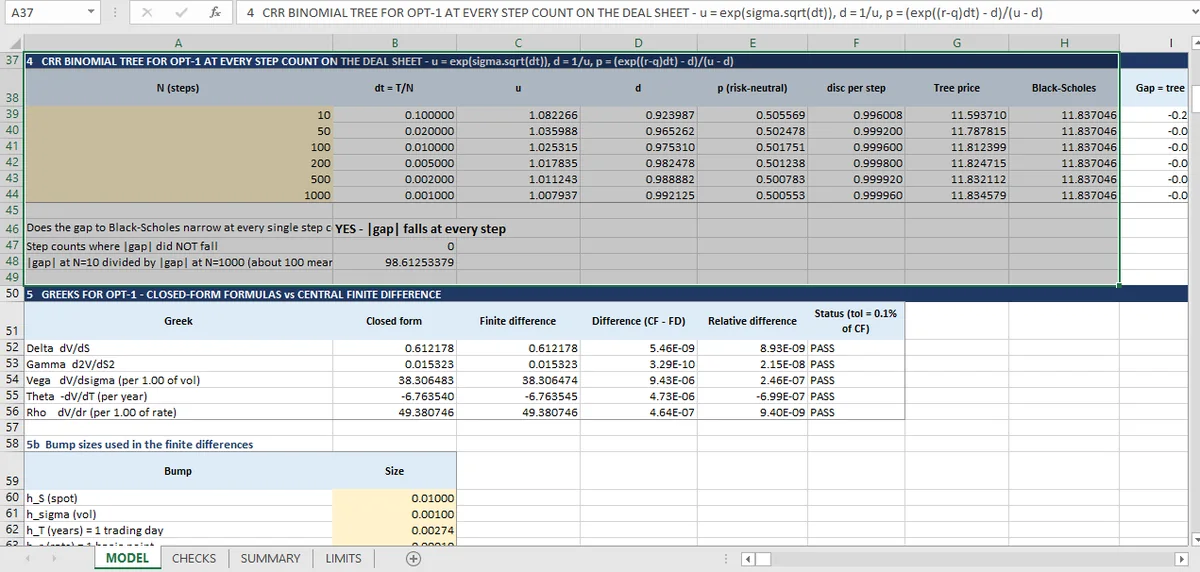
A CRR tree converges to Black-Scholes at O(1/N): the gap is 0.243 at 10 steps and 0.0025 at 1,000, a ratio of 98.6 against a theoretical 100. The American put is the case where the tree has no closed form to check against.
A binomial tree approximates a continuous price process with a discrete one. The approximation is only worth anything if the discrete answer approaches the continuous one as the lattice gets finer. It also helps to see that happening at the step counts you actually run. The same convergence question applies to simulation, where Monte Carlo error is measured rather than assumed.
The workbook runs the CRR lattice at six step counts on the same option and compares each with the closed form.
| N | Tree price | Black-Scholes | Gap |
|---|---|---|---|
| 10 | 11.5937 | 11.8370 | −0.24334 |
| 50 | 11.7878 | 11.8370 | −0.04923 |
| 100 | 11.8124 | 11.8370 | −0.02465 |
| 200 | 11.8247 | 11.8370 | −0.01233 |
| 500 | 11.8321 | 11.8370 | −0.00493 |
| 1,000 | 11.8346 | 11.8370 | −0.00247 |
Two things are visible.
The gap falls at every step. The workbook counts the failures: the number of step counts where the absolute gap failed to shrink. It is zero.
The ratio is close to 100. The gap at N=10 divided by the gap at N=1,000 is 98.6. If the error is O(1/N), the ratio should be 100, and 98.6 is the difference between the asymptotic rate and what six points can show. That is the empirical confirmation of the convergence order, not just of the convergence.
The Second Lattice Check: Terminal Sum vs Backward Induction
A second check compares two completely different ways of evaluating the same tree: rolling the payoff back through the nodes, versus summing the terminal payoffs weighted by their risk-neutral probabilities and discounting once.
At N=10, the two give 11.59370952300479 and 11.59370952300475. The difference is 4 × 10⁻¹⁴. That check is worth having because the two implementations share almost no code: one walks the tree backwards, the other enumerates the last layer. An indexing error in either would show up immediately.
Where the tree is the only option
The American put, OPT-7, has no closed form. Its value, 8.307, comes entirely from the lattice, and two checks support it.
Early exercise cannot be worth less than zero. The American value must be at least the European value on the same terms. Here 8.3073 against 7.9160, a premium of 0.3913. The check is one-sided for a reason: a negative early-exercise premium is not a small error, it is an impossibility.
The lattice has converged. N=200 gives 8.307296 and N=100 gives 8.301168: a gap of 0.0061, about 0.07% of the value. That is the number the limits sheet quotes as the discretization error, and it is the reason the American price should be read to three significant figures rather than six.
The Warning About Irregular CRR Convergence
The workbook's limits sheet contains a note that most convergence tables never state:
> Gap narrowing at every step count is observed here, but CRR convergence is O(1/N) and can oscillate when the strike sits between nodes. Do not read the pass as a general theorem; it holds for these six step counts and this strike.
That is the right level of care. CRR trees produce sawtooth error patterns when the strike falls between two nodes, because the option's payoff kink lands at different distances from the nearest node at different step counts. Here the strike is at the money and the six counts happen to avoid the worst of it.
A reader who wants the guarantee should run adjacent step counts (199 and 200, say) and confirm they are close. If they differ by much more than the O(1/N) expectation, the strike is landing awkwardly and an average of odd and even steps, or a different parameterization, is the fix.
What the Convergence Table Establishes
The tree and the closed form agree with a gap that shrinks at the predicted rate, and the tree's two evaluation routes agree to 10⁻¹⁴. That is evidence the lattice implementation is correct.
None of that proves the model prices the option correctly, because the closed form it is compared against uses the same volatility input. The comparison is conditional on the shared input: a wrong σ moves both methods together, so the agreement tests the lattice, not the input. That is the structural limitation of every check in this workbook, and the reason the integration article puts the 17 checks in that context. The closed form the lattice converges to is covered in the analytic versus numeric piece, and the sensitivities computed from it in the Greeks article. The derivatives hub collects the full 17-check sheet.
The lattice runs at six step counts in the same Mica sheet, so the convergence table updates with the inputs. Six counts side by side is the Excel modeling approach that makes the pattern visible.