
Seventeen is not a small number here
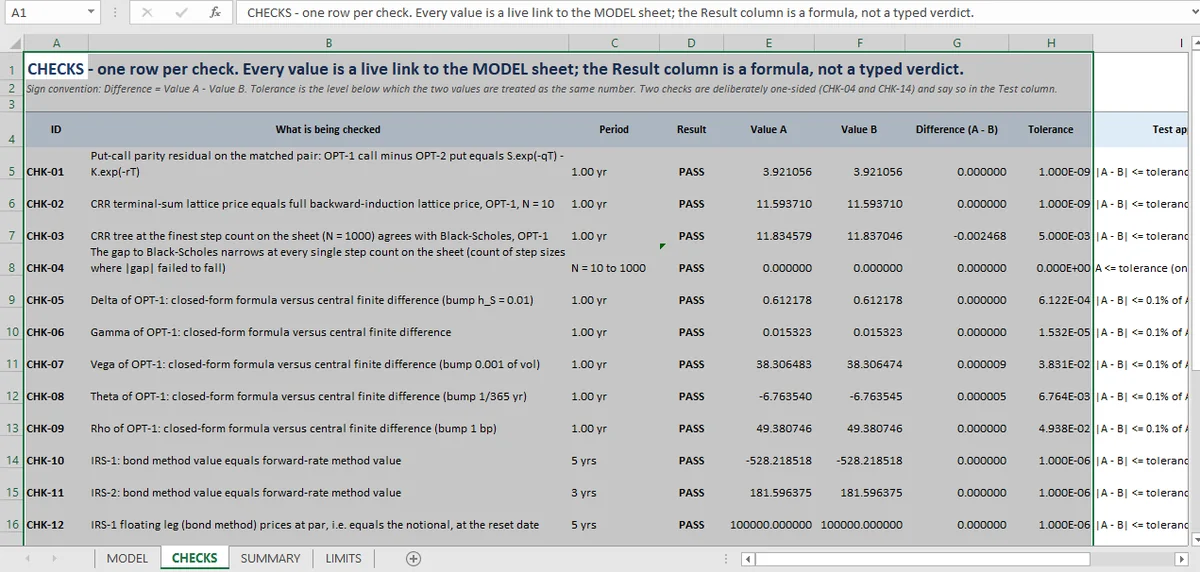
Seventeen checks is not a small number when each is a different kind of evidence: parity, lattice structure, convergence, finite differences, method agreement, bounds and one inversion. None of them tests against an external price.
The three-statement model in this series runs 99 checks. The capital budgeting model runs 67. The pricing engine runs 17, and the reason is not that it is less carefully built.
A three-statement model has many periods and many linked schedules, so a single identity applied to nine columns produces nine checks. A pricing engine has few instruments and no periods: its complexity is in the mathematics of one number, and the way to test that is not to repeat an assertion but to compute the same quantity by a different method.
Seventeen checks, six kinds of evidence.
| Kind | Checks | What it establishes |
|---|---|---|
| Parity | 1 | Two prices satisfy a relationship independent of the model |
| Lattice structure | 1 | Terminal-sum and backward-induction evaluations agree |
| Convergence | 2 | The tree approaches the closed form, and its step-to-step gap falls |
| Finite difference | 5 | Analytic Greeks match numerically bumped ones |
| Method agreement | 4 | Two valuation methods for each swap, plus floating leg at par |
| Bounds and inversion | 4 | American ≥ European, lattice stable, implied vol reproduces the quote |
What each kind can and cannot see
Parity is the only check that does not reuse the pricing formula twice. C − P = S·exp(−qT) − K·exp(−rT) relates a call and a put through spot, strike and the discount factor. The residual here is 7.1 × 10⁻¹⁵. It catches sign errors, dividend-handling errors and discounting errors. It cannot catch a volatility that is wrong for both legs.
Lattice structure and convergence test the numerical method against itself and against the closed form. The gap at N=1000 is 0.0025, and it falls at every one of six step counts. These catch implementation errors in the tree; they are conditional on the shared closed form, so an error shared with it is outside what they test.
Finite differences test five Greeks against five analytic formulas. All agree to better than 10⁻⁶ relative. They catch a wrong analytic derivative: a missing discount factor, a sign flip in theta. They cannot catch a wrong specification of the model.
Method agreement on the swaps is the strongest structural check on this sheet: the bond method and the forward method share only the cash-flow definition, and they agree to machine precision on both swaps, with the floating leg pricing at par from both sides.
Bounds and inversion are one-sided sanity checks plus the implied volatility solve. American ≥ European (8.3073 against 7.9160) is a constraint no correct model can violate. The lattice stability check at N=100 versus 200 puts a number on the discretization error: 0.0061.
The limit that applies to all seventeen
The workbook states it in its own limits sheet, as the last of twenty:
> None of the 17 checks is a test against an external price. A clean check sheet proves the arithmetic is self-consistent, not that the model is suitable for live risk.
That is the correct framing for every model in this series, and it is sharper here than anywhere else. An option price is a function of six inputs; the model checks five relationships among them and none of the inputs. A 25% volatility typed from a term sheet is unexamined by any check, and it is the input that moves the price most.
The flat curve is the second unexamined input. Both swaps are valued on a single 4.00% continuous zero rate; no term structure, no OIS basis, no separate projection curve. The two-method agreement would survive a wrong curve perfectly, because both methods use the same discount factors.
How to read a pricing engine's check sheet
Three questions, in order.
Does anything compare against a number the model did not produce? Here, only parity, and only in the weak sense that it relates two prices rather than generating an independent one. A model with no external data cannot have an external check, and a check sheet that claimed one would be lying.
Is anything checked two ways? Method agreement and finite differences are the two-route checks, and they are the ones that catch wiring. A sheet with only ties and bounds is a sheet that verifies its own arithmetic.
Is the discretization error quantified? The American price depends on it. Reporting 8.307296 to six decimals when the step-size error is 0.006 is a precision claim the model cannot support; reporting 8.307 is honest.
The engine does all three of those reasonably and says so where it does not. That is what makes the 17 checks worth reading: not the count, but that each one states what it is evidence for. The two-method check on the swaps is in the swap article, the finite-difference checks in the Greeks piece, the convergence table in the lattice article, and the one external comparison in the implied volatility solve.
The same check-writing mechanics are in the Excel-for-finance guide, and the DCF walkthrough shows how a cash-flow row is built from scratch.
Every instrument on the deal sheet was built in one Mica workbook, so the check sheet covers exactly what was priced and nothing else.