
A swap is two bonds
A swap can be valued as two bonds or as a strip of forward rates. On a flat 4% curve the five-year par rate is 4.081%; paying 4.20% is worth −528.22, receiving 3.95% is worth −181.60. Both methods agree to machine precision.
An interest rate swap is an exchange of a fixed rate for a floating rate on the same notional. It can be valued as the difference between two bonds (one paying fixed, one paying floating), or as a strip of forward rate agreements, each discounted separately.
Those are two genuinely different ways of doing the arithmetic. They are also two ways of expressing the same cash flows, so they must agree exactly. Four checks in this workbook test that they do.
The two methods
Bond method. Discount the fixed leg's coupons and final notional at the curve. The floating leg is worth par at a reset date: a floating-rate note that resets to the market rate is always worth its face value. So its present value is simply the notional. The swap value is the difference.
Forward method. Implied forward rates are extracted from the discount factors, applied to the notional for each period, and the resulting cash flows are discounted. No par argument is used.
The bond method depends on one non-obvious fact. The forward method builds it up from first principles. If the par fact is wrong, or if it is applied at the wrong date, the two methods diverge.
The two swaps
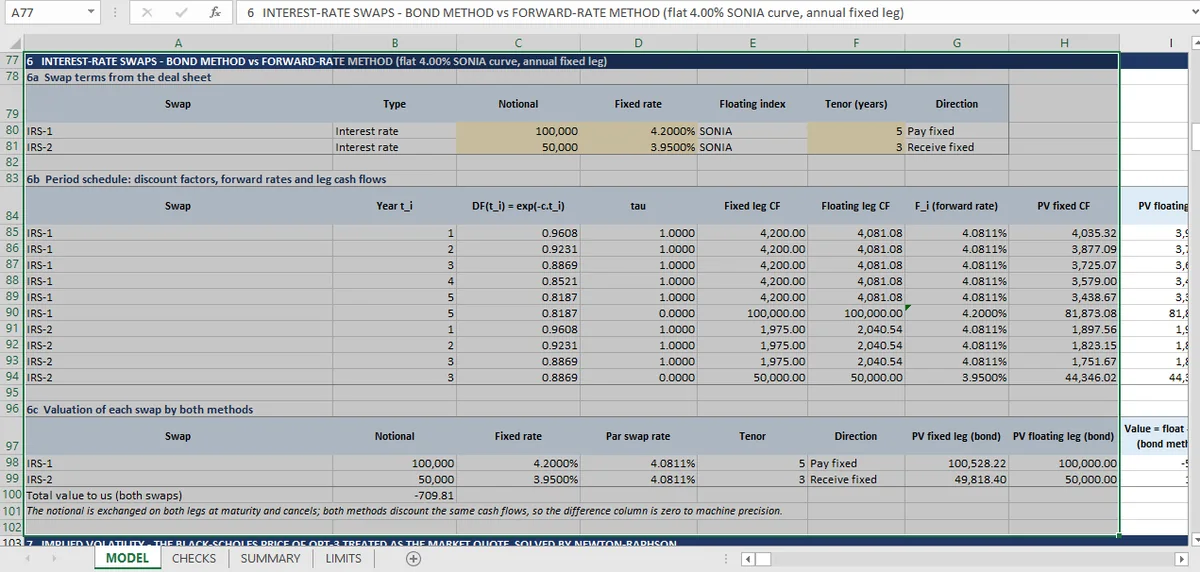
On a flat 4.00% continuous curve with annual payments, the five-year par rate is 4.081%: one minus the five-year discount factor, divided by the sum of the five annual factors.
| Swap | Notional | Fixed | Par at its tenor | Value to us |
|---|---|---|---|---|
| IRS-1, 5y, pay fixed | 100,000 | 4.200% | 4.081% | −528.22 |
| IRS-2, 3y, receive fixed | 50,000 | 3.950% | 4.081% | −181.60 |
Both signs follow from the fixed rate against the par rate. Paying 4.20% when the market is 4.081% costs money, and the cost is roughly 12 basis points of notional per year for five years, discounted. That lands at 528. Receiving 3.95% when the market pays 4.081% costs money as well. The receiver is being paid below fair value, so the position is worth −182 on half the notional.
That second sign is worth spelling out, because the check sheet reports +181.6 for the same swap. The checks measure the quantity PV(floating) − PV(fixed), which is always the value of a *pay-fixed* position; the check is direction-agnostic because it computes that quantity regardless of the trade direction. The summary reports value to us, which flips the sign for a receive-fixed trade. Both numbers are right; the workbook carries the direction flag in its own column, and a reader who compares the two sheets without noticing will think one of them is wrong.
What the checks establish
Four checks, and each closes a different hole.
The two methods agree on each swap. The difference between the bond-method value and the forward-method value is zero to machine precision on both. That check validates the par assumption indirectly. If the floating leg did not price at par, the bond method would produce a different answer from the forward strip.
The floating leg prices at par. Both swaps' floating legs are 100,000 and 50,000 against notional of the same amount, to within 10⁻¹⁴. This is the assumption the bond method rests on, checked directly rather than assumed.
What none of the four checks establishes is whether 4.00% is the right curve. A flat curve is the workbook's stated limitation: no bootstrapped term structure, no separate projection curve, no OIS basis. On a real curve, both swaps would be valued against a discount curve and a projection curve that are usually not the same, and swap values would shift with the basis.
Why two methods is the right standard
A single method cannot tell you whether it is right. If the forward method alone produced −528.22, a reader would have to check the forward extraction, the discounting and the day count by hand to trust it.
Two methods, sharing only the cash-flow definition, catch the class of error that single-method models hide: a sign convention applied to the wrong leg, a discount factor applied at the wrong date, a par assumption used at a non-reset date. The checks here are tight, one part in 10⁻¹², so any of those errors would show immediately.
The same logic drives the option side of the workbook, where the closed-form price and the lattice have to converge. It is the most reusable idea in the whole topic: wherever a quantity can be computed two ways, compute it two ways and subtract. Simulation has its own version: Monte Carlo convergence checks a numerical estimate against a second route.
The lattice convergence article is the option-side version of the same argument, the Greeks article applies it to derivatives rather than prices, the closed form those swaps are not priced with is in the Black-Scholes article, and all 17 checks are collected in the derivatives hub.
Both valuation routes sit in the same Mica sheet, so every recalculation subtracts the forward method from the bond method. Putting the two routes in one sheet is also the Excel layout that keeps the subtraction visible.