
Two ways of pricing the same contract
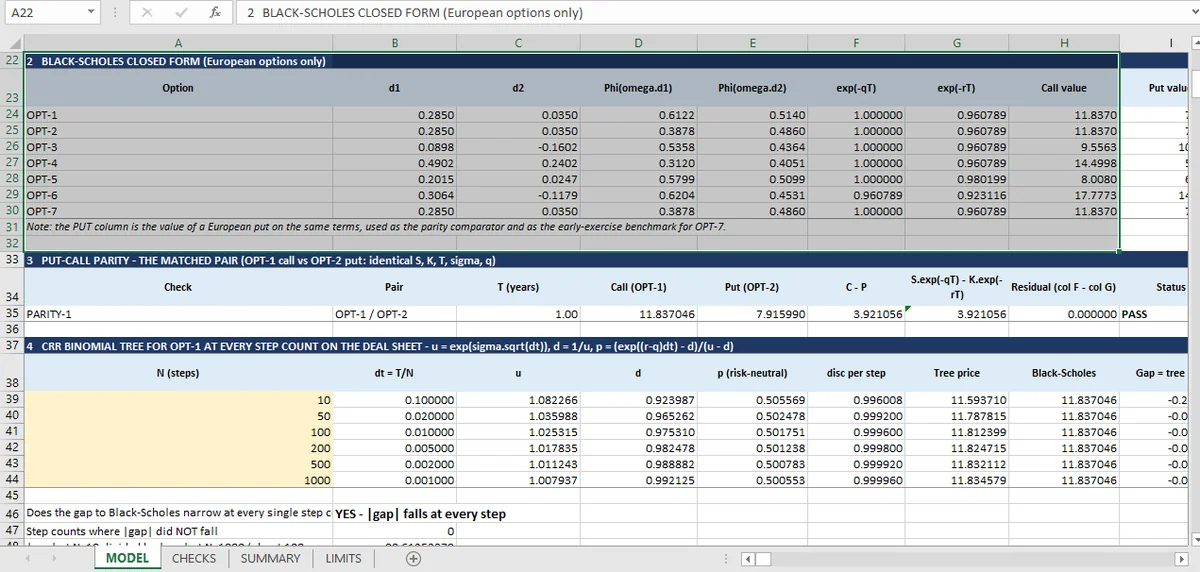
A one-year 100-strike call at 25% volatility prices at 11.837 from the closed form and 11.835 from a 1,000-step tree. The 0.0025 gap is discretization, not error, and it shrinks at every step count.
Black-Scholes gives a closed form: plug in spot, strike, time, rate, volatility and dividend yield, and the price arrives in one expression. A binomial tree gives a numerical approximation: build a lattice of possible prices, roll the payoff back through it, and take the value at the root.
For a European call on a non-dividend-paying stock, the two must converge. The only question is how far apart they are at any given step count, and whether that distance behaves the way theory says it should.
The closed form, in its parts
For OPT-1 the inputs are plain: a one-year European call, spot 100, strike 100, 4% rate, 25% volatility, no dividend. The workbook computes:
- d₁ = 0.285, d₂ = 0.035
- N(d₁) = 0.612, N(d₂) = 0.514
- Price = 11.837
The deal sheet was an image, and some terms needed more than one OCR pass. Parity relates the call and the put on the same terms, so a misread term moves both legs together; the term sheet is the premise, not a check target.
Those two probabilities are not decoration. N(d₁) is the delta: 0.612. The workbook also computes it by finite difference, and the two agree to eight significant figures. N(d₂) is the risk-neutral probability of finishing in the money. Every Greek comes out of the same two numbers. So an error in d₁ reaches the price, the delta and the hedge ratio at once.
The tree, at a thousand steps
The Cox-Ross-Rubinstein lattice splits the year into N steps, with up and down factors set by volatility and time. At N=1000 the tree gives 11.8346 against the closed form's 11.8370. That is a gap of 0.0025, or 0.02% of the price.
The gap is not an error; it is what discretizing a continuous process costs, and the cost has a known shape: for CRR the error is O(1/N), so doubling the steps should halve the gap. The convergence article walks the table that shows exactly that. The same question is asked of a simulated price in simulation convergence, where the standard error is the gap.
Why the tree exists at all
If the closed form is exact, why compute the lattice?
Because the closed form only exists for European options on a single underlying with continuous dividend yield. It has no answer for an American option, where early exercise is a decision rather than a boundary condition. OPT-7 on the deal sheet is an American put. Its price, 8.307, exists only because the lattice can test exercise at every node.
That is the trade. The closed form is exact but narrow. The lattice is approximate but general. And where both apply, the lattice is the check on the closed form.
The third route: parity
There is a check in the workbook that is stronger than either price: put-call parity on the matched pair.
Left side 3.9210560847676916, right side 3.9210560847676845, residual 7.1 × 10⁻¹⁵.
Parity is stronger than the tree comparison for one reason: it does not require re-computing Black-Scholes. It is an identity relating a call and a put, and it holds whatever model produced them. The tree-versus-closed-form comparison is conditional on the volatility input: a wrong σ moves both methods together, so the agreement tests the implementation, not the input. Parity would catch a mispriced input that broke the relationship; it cannot catch a wrong σ that affects both legs consistently, but it does catch sign errors, dividend treatment errors and discounting errors.
What the three routes add up to
Together, the closed form, the lattice and parity cover three different failure modes:
- Formula errors: caught by the closed form against the tree.
- Discretization errors: caught by the convergence pattern across step counts.
- Relationship errors: caught by parity, independent of either pricing method.
None of them catches a wrong market input. The limits sheet says so explicitly: the 17 checks test algebraic consistency, and none is a test against an external price. A price of 11.837 that agrees with a tree, satisfies parity and passes 17 checks is still only as good as the 25% volatility typed from the deal sheet.
The convergence article is where the step-count table lives, the Greeks article applies the same two-route logic to sensitivities, and the derivatives hub holds the complete check sheet.
The formula and the lattice are both written in Mica, leaving the two prices in adjacent cells and the gap as a formula rather than a claim. That pairing is the workbook pattern the series uses for every two-route check.