
The simplest derivative, and the one this engine does not price
A forward price is spot carried at the funding rate: F = S × exp((r − q)T), which gives 104.081 on spot 100 at 4% for one year. A future is the same thing with daily settlement, and the gap between the two is the basis.
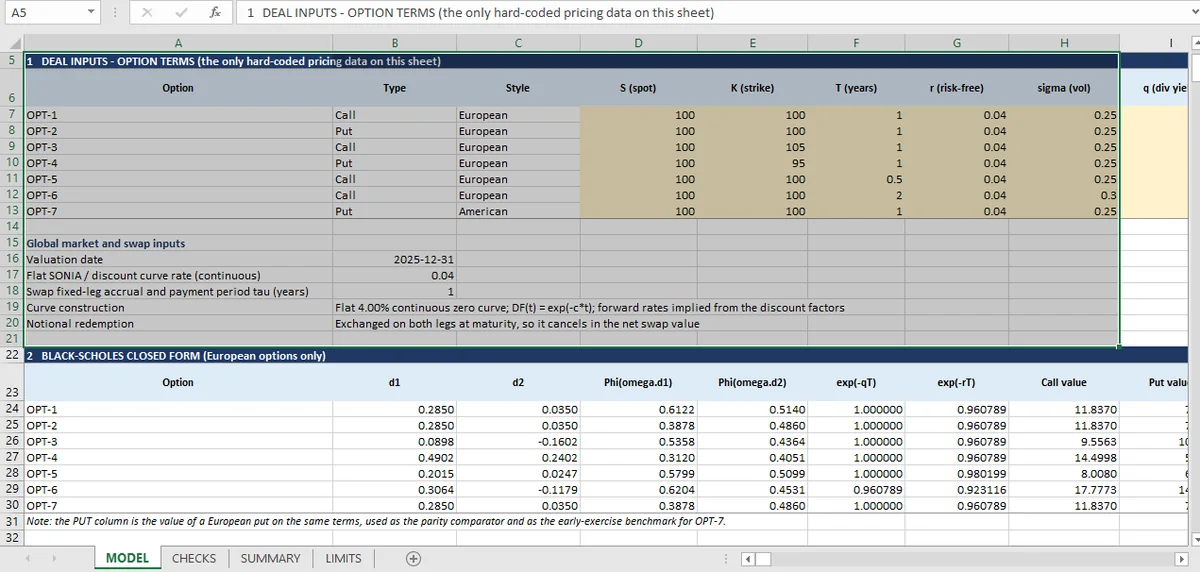
The deal sheet behind this topic lists seven options and two interest rate swaps. There is no forward and no future on it, so nothing in the workbook's 17 checks touches the basis.
That is not a gap in the engine so much as a boundary of the mandate, and it is worth knowing where the boundary sits, because the forward is the building block every other instrument on the sheet is made of.
What a forward price is
A forward price is spot carried forward at the funding rate, less whatever the asset pays out along the way:
With spot at 100, a 4.00% continuous funding rate and no dividend, one year forward is 104.081. Add a 2% continuous dividend yield and it becomes 102.020. The holder of the forward does not receive the dividend, so the forward price has to be lower by its future value.
That is the whole model. Everything else about a forward is convention: the day count, the settlement date, whether the underlying pays a discrete dividend rather than a continuous yield.
What a future adds
A future has the same economic payoff and one structural difference: it is marked to market daily. The holder's gain or loss is settled in cash every day rather than at maturity.
That matters for two reasons.
Funding. Daily settlement means the P&L is financed day by day at whatever the short rate is on that day, not at a single rate locked in at inception. If rates are correlated with the underlying, and they usually are negatively for equities, the expected funding cost differs from the forward's, and the futures price differs with it.
Convexity. The daily settlement creates a small convexity adjustment. For a future on a rate, the adjustment is material enough to matter at long maturities; for an equity index future, it is usually measured in basis points.
The basis is the difference between the two prices, and it is a function of the rate path, not of the underlying. That is why the basis is quoted as a rate rather than a price.
Why the workbook has no basis check
Three reasons, and the third is the honest one.
The deal sheet does not include a future, so there is nothing to compare. The engine's curve is a flat 4.00% zero curve with no term structure, so it cannot represent the interest-rate path that drives the convexity adjustment. And the model has no repo, no borrow and no collateral, so the funding leg of a real basis trade has no representation.
What the workbook does have is the forward rate implied by its own curve, and that rate is visible: the five-year par swap rate on a flat 4.00% curve with annual payments is 4.081%.
That number is worth pausing on. The par rate is the fixed rate that makes a swap worth zero, and under a flat curve it is a pure function of the discount factors: 1 − DF(5), divided by the sum of DF(1..5). The par rate is the curve's statement about the average forward rate over five years, and it is computed rather than typed. The curve underneath it is a flat zero curve, the same simplification the bond workbook makes when it solves a yield from a price.
What a basis check would look like
If a future were on the sheet, three assertions would cover it.
The forward is arbitrage-free against spot and funding. Given S, r and q, the forward price is determined. A check recomputes it from the components and compares, which catches a hard-coded price.
The futures-forward spread has the right sign and a plausible size. Not a tight tolerance, since the adjustment is model-dependent, but a bound. A basis that is larger than the funding cost over the period is a red flag.
The parity of the whole structure. A synthetic forward assembled from a call and a put must price the same as the forward. That is the same parity check the workbook already runs on OPT-1 and OPT-2, extended to the forward.
None of those is in the workbook. What is in the workbook is the machinery to price the options and swaps that the forward underlies, and a check sheet that establishes the machinery is internally consistent. The swap article shows where the par rate comes from and why both methods of valuing a swap land on it. The two pricing methods that the forward underlies are compared in the Black-Scholes article, the tree that prices an American option without a forward is in the convergence article, and the derivatives hub carries the full 17-check sheet.
What Mica prices is what the deal sheet contains, which is why the workbook shows a par swap rate rather than a forward it was never asked for. The boundary is stated rather than papered over — the scope discipline how Mica works is built around.