
Every Greek can be checked by bumping
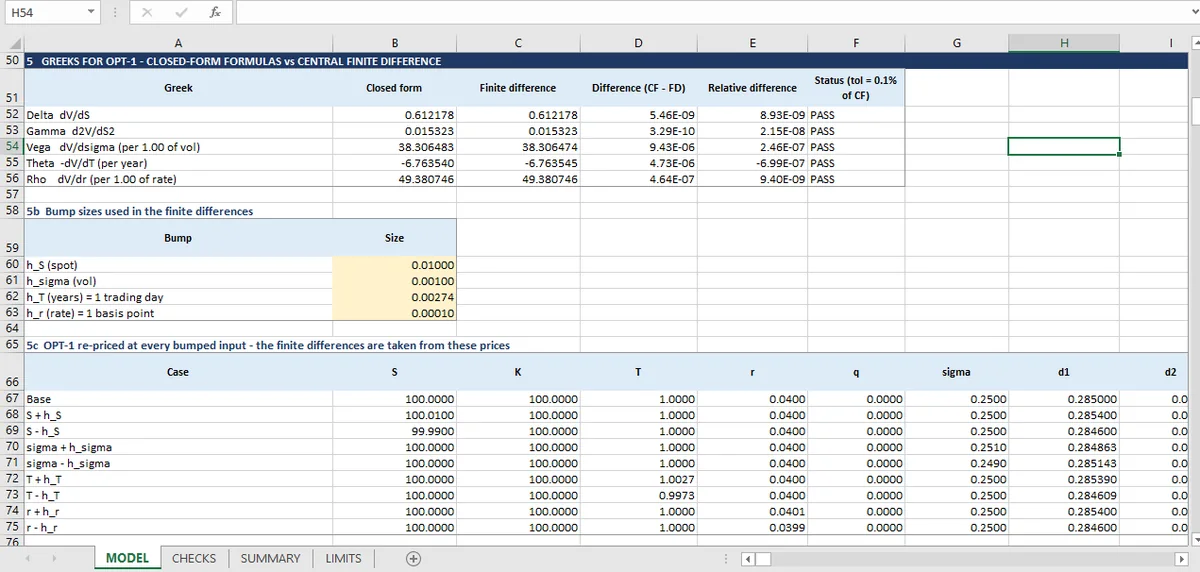
Delta, gamma, vega, theta and rho are each computed twice: from the closed-form formulas and by central finite difference. All five agree to better than 0.0001%, with vega at 38.31 per unit of volatility and rho at 49.38 per unit of rate.
A Greek is a derivative: delta is the change in price for a change in spot, vega for a change in volatility, and so on. The closed-form versions are analytic expressions. The numerical versions are what you get by moving the input a little and dividing.
If both are right, they must agree. The workbook computes all five for OPT-1 and compares.
| Greek | Closed form | Finite difference | Relative difference |
|---|---|---|---|
| Delta | 0.6121779290 | 0.6121779236 | 8.9 × 10⁻⁹ |
| Gamma | 0.0153225932 | 0.0153225929 | 2.1 × 10⁻⁸ |
| Vega | 38.30648308 | 38.30647365 | 2.5 × 10⁻⁷ |
| Theta | −6.76354024 | −6.76354497 | −7.0 × 10⁻⁷ |
| Rho | 49.38074646 | 49.38074599 | 9.4 × 10⁻⁹ |
All five are within the stated tolerance of 0.1% of the analytic value, with four of them six to eight orders of magnitude inside it.
The bump sizes, and why they are choices
A finite difference has two sources of error and they pull in opposite directions.
Truncation. A central difference approximates the derivative with an error of order h². Make h small and this error falls.
Round-off. Subtracting two nearly equal numbers loses precision. The error grows as h gets small, roughly as machine epsilon divided by h.
The optimal bump is where the two balance, around the cube root of machine epsilon times the scale of the variable, in the region of 10⁻⁵ to 10⁻⁶ of the input for double precision. The workbook's choices are:
| Greek | Bump | Note |
|---|---|---|
| Delta, gamma | 0.01 (absolute) | 1 basis point of 100; 0.01% of spot |
| Vega | 0.001 of volatility | One tenth of a volatility point |
| Theta | 1/365 of a year | One calendar day |
| Rho | 1 basis point of rate | 0.0001 |
Those are larger than the theoretical optimum, which is the right trade for a spreadsheet: formulas stay legible, the numbers stay stable, and the residual error is still six orders of magnitude below anything that matters.
Two Unit Details That Change How You Read the Greeks
Vega is per one unit of volatility, not per point. 38.31 means the price changes by 38.31 for a move in σ from 0.25 to 1.25. Divide by 100 for the per-volatility-point figure: 0.383 per point. A reader who quotes "vega of 38" on a desk will be understood to mean 38 per 100 vol points, which is the same number only if the units are stated.
Rho is per one unit of rate. 49.38 for a move from 4.00% to 104.00%. The same trap. Divide by 10,000 for the per-basis-point figure: 0.0049 per bp.
The workbook states both units on the sheet, which is the only defense against this class of error. A Greek with no unit is not a number anyone can use.
Why gamma is the one to watch
Delta and gamma are the first and second derivative of the same quantity, and gamma is what makes a delta hedge fail. At 0.0153, a one-point move in spot changes delta by about 1.5 percentage points, or 153 basis points. For a position of any size, that is the difference between a hedge that holds and one that drifts.
The finite-difference check on gamma is therefore stricter in practice than its tolerance suggests. It is computed as the second difference of the price, which is a subtraction of two subtractions, so it is the noisiest of the five. Agreement to 2 × 10⁻⁸ is evidence that the pricing formula is smooth and correctly implemented, not merely that the bump was well chosen.
What the five checks prove
The five checks prove that the closed-form Greeks and the numerical ones are the same function. They catch a wrong denominator in a formula, a sign error in theta, a mis-scaled vega, and any implementation where the analytic and numerical paths diverged. The bond workbook uses the same bump to check duration and its limits, where a mislabeled definition fails the same test.
The comparison is conditional on the shared pricing formula: a specification error, such as wrong dividend treatment or wrong day count, moves both routes together, so the check tests the implementation, not the specification. Nor do they cover the American option or the swaps: the limits sheet says Greeks are computed for OPT-1 only, and no DV01 is reported for either swap.
The implied volatility article uses vega directly, because it is the denominator of the Newton step. The closed form the Greeks differentiate is in the Black-Scholes article, the lattice that prices the American option is in the convergence article, and the full 17 checks, with their cell references, are in the derivatives hub.
In the Mica build, the analytic Greek and the bumped price sit side by side, so the finite-difference check runs on every recalculation. That adjacency is the Excel audit layout the series relies on.