
What AI Financial Modeling Rankings Measure
Published rankings score speed, formatting and data accuracy. None of the tools tested forecast interest off the balances that generate it, so none built a real three-statement model. The missing axis is verifiability: whether the finished file carries checks a reviewer can re-run.
The best-known test of AI tools for financial modeling is Wall Street Prep's. It asks each tool to build a fully integrated three-statement model for Apple, three years of history from the 10-K and Q4 release, four years of forecasts from consensus, formatted the way a bank formats it. The tools are then graded like a training analyst.
The results, from the published ranking: Shortcut 5.9, Claude 5.5, Copilot 4.4, ChatGPT 2.5. A low-tier junior analyst scores 6.4; mid-tier 7.9; top-tier 9.4. No tool reached the bottom of the human range.
The categories are the ones that matter to someone who has to hand a model to a colleague: how quickly the tool understood the assignment, whether the historical figures were right, whether the formatting looked like a bank's, whether the sourcing held up, and whether the forecast structure was sound.
That is a good test, and it answers a real question: if I ask a tool to draft a model, how much of the draft will I keep. What it does not answer is the question that decides whether the model can be used at all: whether the finished file can be checked.
What the Rankings Leave Out: Verifiability
Two of the categories in that test come close to verifiability without reaching it. Sourcing asks whether the tool explains where a number came from. Structure asks whether the statements hold together. Neither asks the question a reviewer asks: can I re-run this and get the same answer, and can I find the place where it stops being true.
The benchmark does report one result that shows the cost of that gap. Under circularity, its own heading is All failed: "no tool forecasted interest income and expense from cash and debt balances", and therefore "there was no circularity embedded in the model". On debt: "None handled debt correctly," and most "relied on plugs rather than proper integration."
Those are not small omissions in a three-statement model. Interest that does not respond to the balance it is charged on is a constant, and a balance sheet that balances because of a plug is a balance sheet that passes the identity in every period while being wrong in every period. The tools did not fail to solve a hard problem; they avoided the problem and still scored 4.4 to 5.9 out of ten.
A ranking cannot see this, because a ranking compares outputs to a rubric. Verifiability is a property of the route, not of the output.
What a checkable model would have to score on
The alternative is not a better rubric for the same draft. It is a different question, asked of the file rather than the tool: how many assertions does the finished workbook satisfy, and can someone other than its author demonstrate that?
Six check types cover it, and each produces a number rather than an impression:
| Check type | What it produces | Why a ranking misses it |
|---|---|---|
| Structural | Identities held, per period | A model can balance in the last column only |
| Consistency | Formulas that match across periods | A hand-patch looks like a formula |
| Constraint | Constraints satisfied by the solution | An out-of-bounds optimum still looks like an answer |
| Convergence | Two methods, one number, one difference | One method cannot audit itself |
| Sensitivity | Direction and plausibility of response | A smoothly wrong model passes everything else |
| Known behavior | Quirks recognized, not mis-scored | A correct model can be marked wrong |
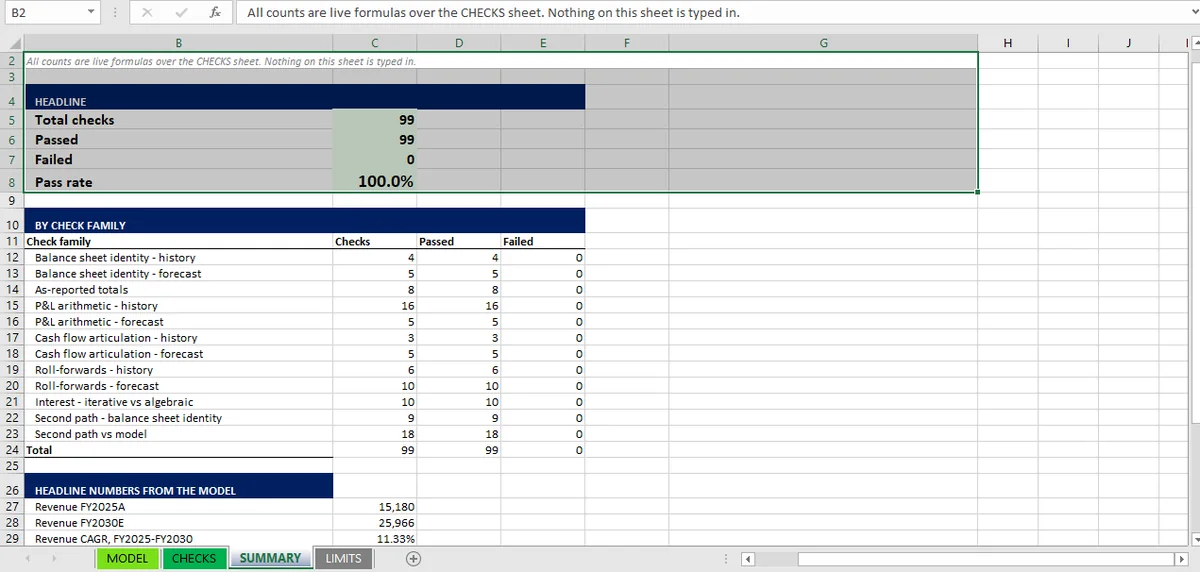
The workbook in this series was built to produce exactly those numbers, and the result is unglamorous: 99 checks, 99 passes, one finding: closing cash of −1,113 because no funding line exists. The number that matters is not the 99. It is the last one, which no score out of ten would have surfaced.
How the tools compare on checks
They cannot yet be compared, and it is worth saying why rather than implying a ranking.
Running the check protocol against a tool means giving it the same input pack, holding the same answer key, and grading the workbook it returns against the same ninety-nine assertions. That has been done once, on one model, by one team (this one), and the result is a demonstration rather than a survey.
What can be compared, from published tests, is how the tools behave at the points where checks usually fail:
| What is measured | Shortcut | Claude in Excel | Copilot | ChatGPT |
|---|---|---|---|---|
| Interest forecast off cash and debt balances | No | No | No | No |
| Debt schedule handled correctly | No | No | No | No |
| Overall score, published test | 5.9 | 5.5 | 4.4 | 2.5 |
Four tools, one answer on the two points that decide whether a three-statement model is a model. That is a published finding about a specific test on a specific date, and it is the strongest evidence available for the claim that drafting speed and verifiability are different axes.
The result is not proof that no tool can pass a check protocol. The protocol has been applied once, and the tool that passed it was Mica, a result that should be read with the obvious caveat attached: the same team built the model and wrote the checks. The caveat explains why every article here distinguishes a cross-check inside one workbook from an external audit, and why the numbers are published in full rather than summarized.
What to ask a vendor
If you are choosing a tool for work that will be relied on, the ranking is a starting point and the following five questions are the rest of it. They are answerable in a demo, and the answers are falsifiable.
- Does it leave a check sheet in the file? Not a report, not a summary in the chat window: rows in the workbook that recompute when the model changes.
- Does it compute anything twice? Interest, yield, duration, option price. If the answer is no, ask which quantity it does verify, and in what way.
- Can I delete a schedule and see what breaks? This tests whether the model's parts are linked or merely adjacent.
- What does the limits sheet say? A tool that produces no limits sheet is claiming the model covers everything, which is the one claim that is always false.
- Can I re-run the same prompt on the same file tomorrow? Locality matters here: if the workbook leaves the machine between runs, the evidence trail has a gap.
Mica keeps assumption inputs separate from calculated cells, so a scenario change can be traced to the outputs it touched. That is one answer to questions one and five, and it is verifiable in the workbook rather than in a marketing page.
The tool landscape behind those questions is compared in the free Excel AI tools guide and the ChatGPT/Claude/Copilot comparison; the action-bot trend piece is the category-level view.
Who should read the ranking, and who should not
The published scores answer a real question for one kind of buyer and a misleading one for another.
If you are drafting to think, the ranking is close to exactly what you need. A tool that gets 5.9 and finishes in fifteen minutes is a genuine change to how quickly you can produce a first pass, and the errors that keep it out of the human range are the ones you would have made anyway on a first pass. Use it, then rebuild the parts that matter.
If you are drafting to hand over, the ranking is the wrong instrument. The score describes a draft that a competent analyst would still have to finish, and it says nothing about whether the finished file can be reviewed by someone who was not in the room. That is the check sheet question, and none of the four tools currently answers it.
If you are buying software for a team, ask for both. The score tells you whether the tool will be adopted; the check sheet tells you whether the output can be defended. A tool that scores well and leaves no evidence has moved the review cost from the analyst to whoever signs off, which is a real transfer of risk, not a saving.
How to run the check protocol yourself
None of this requires a vendor to cooperate. The protocol runs on any workbook, in an afternoon, with the file already open.
Pick five assertions, not ninety-nine. One balance-sheet identity per period, one roll-forward, one articulation test, one two-method comparison, one sensitivity direction. Five is enough to tell a model from a draft, and it is small enough to finish.
Write them as formulas in a spare sheet. Each row should have the two values, the difference and a pass flag. A check that is described in prose is a wish; a check that is a cell is evidence.
Name the cell each check reads. This is the step people skip, and it is the step that turns a red flag into a location. Without it, a failing check tells you the model is wrong and not where.
Break the model on purpose. Change one driver, confirm the checks still pass, change it back. If a check flips when nothing should have moved, the check is wrong or the linkage is. Either way, you have learned something the static file would not tell you.
Keep the sheet in the file you send. A check sheet that lives in your own working copy is a claim about a model that no longer exists the moment it is sent. The one that travels makes the model auditable by whoever receives it.
The protocol above is the same one described in the six check types, applied to whatever tool produced the file. It is deliberately boring, and its value is that it does not depend on trusting the person who ran it.
What the Ranking Means for Choosing a Tool
The ranking tells you about drafting speed, not about whether the finished model can be checked.
Three conclusions, in order of confidence.
Drafting speed is solved for the tools and prompts in this published test, and no longer differentiates them. Every tool in the test produced a three-statement model within about an hour, and the two leaders did it in roughly fifteen minutes. Choosing on speed is choosing on the axis where the spread is smallest.
Verifiability is unsolved and invisible in the rankings. Not one tool in the published test forecast interest off the balances that generate it. That single omission disqualifies a three-statement model from being a three-statement model, and it did not stop any of the four from scoring in the middle of the range.
The check is available to the buyer, not just the vendor. Ask for the check sheet. If the tool cannot produce one, the model is a draft no matter how good it looks, and the twelve ties will take an afternoon to run by hand. That is the whole argument for keeping the model in Excel rather than in a black box: the evidence travels with the file.
For the method behind the numbers, start with the six check types; for the one model that has been taken end to end, the three-statement workbook; for the check that every published tool currently fails, interest circularity.
*This is a comparison of published test results and a methodology, not investment advice. No vendor paid for placement, and the results reported above are quoted from the cited source.*
Inputs sit apart from calculations in a Mica build, which is what makes the check sheet something a buyer can re-run.