
A three-statement model fails at a tie, not at a formula
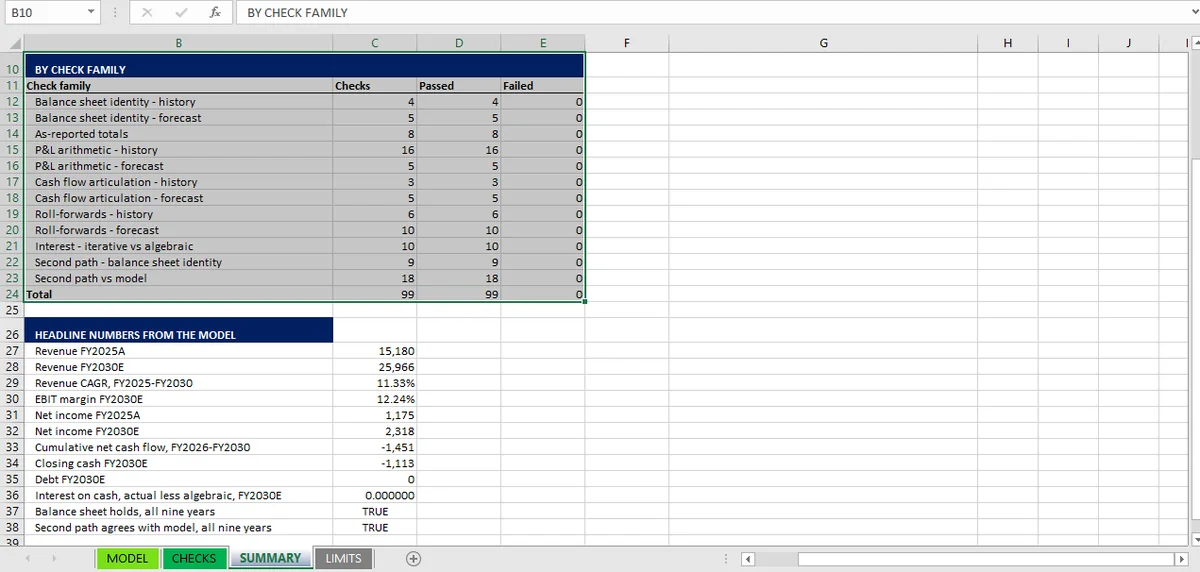
Twelve ties cover a three-statement model: the balance-sheet identity in every period, both reported sides, four income-statement lines, cash articulation, retained earnings, fixed assets, interest computed twice, and a second path. In this workbook all 99 checks behind them pass.
Three-statement models rarely break because a single formula is wrong. They break because a tie stopped holding somewhere in the middle of the forecast. By the time anyone notices, the formula that caused it has been copied across six columns.
The distinction matters because a formula is local and a tie is global. You can inspect =E12-F12 all day and it will look correct; whether it is correct depends on what E12 and F12 contain, and whether they contain the right things depends on nine other schedules. A tie asks the only question that survives that chain: do these two numbers, arrived at by different routes, agree, in every period.
Twelve ties cover a three-statement model built the usual way. They are not twelve different ideas. Several are the same identity applied at a different point in the model, but each one catches a different way of getting it wrong.
Ties 1–3: both sides of the balance sheet
The first three ties are about the balance sheet alone. One tests that the two sides agree; the other two test that each side was built from its own source rather than from the other.
Tie 1: assets equal liabilities plus equity, in every period
This is the one everybody checks, and the one most often checked only at the end.
The identity has to hold in each column, not once at the closing balance. A model can balance in FY2030 because a later adjustment absorbed an error that appeared in FY2026, and that single pass hides four years of a broken schedule. In the workbook behind this article it is nine checks, not one: four historical years and five forecast years, each with its own TRUE/FALSE flag.
Totals run from 8,414 in FY2022 to 15,571 in FY2030, and the identity holds in all nine columns.
Ties 2–3: the reported totals have to add up before anything is forecast
The historical columns are transcribed from published accounts, so they can be checked against themselves before any modeling judgement enters.
Tie 2 asserts that reported total assets equal the sum of the reported asset lines. Tie 3 does the same for the funding side. Four historical years each, eight checks in total. They catch the most embarrassing class of error and the one an AI tool is most exposed to: a transcription that drops or double-counts a line, where the subtotal is then re-derived from the wrong parts and every later tie inherits the mistake.
These two ties are also what stop Tie 1 from being a formality. If total assets are wrong and total liabilities plus equity is wrong by the same amount, the identity still holds. Ties 2 and 3 are the check that the two sides were built independently.
Ties 4–7: revenue down to net income
The income statement is where a model is easiest to get plausibly wrong, because every line can be individually reasonable while the arithmetic linking them is not.
Ties 4–6: one line at a time
Tie 4 tests gross profit against revenue less cost of sales. Tie 5 tests EBIT against gross profit less selling, general and administrative costs (SG&A) less depreciation. Tie 6 tests profit before tax against EBIT less interest. Each runs across the four historical years, four checks each.
They exist because a forecast can be internally consistent and still misstate an intermediate line. If cost of sales is computed from a margin assumption, gross profit will tie; what Tie 4 catches is a margin that has been applied to the wrong revenue figure or in the wrong period. Tie 6 is the one that catches interest being charged twice, or charged on the closing balance while everything downstream assumes the average.
Tie 7: the bottom line, and why history and forecast need different assertions
Net income in the historical years is a transcript, so the tie is net income equals profit before tax less tax: four checks.
In the forecast years the model builds the tax charge as a separate line, so the tie runs the other way: net income equals profit before tax plus the tax charge, where the charge is negative. Five checks. Same arithmetic, opposite sign convention, and writing the forecast tie with the historical sign silently inverts five years of tax. That is not a hypothetical; it is the most common way a forecast income statement ends up 50% of pre-tax profit too high while every individual cell looks reasonable.
Ties 8–10: the three roll-forwards
A roll-forward carries a balance from one period into the next, which makes it the only kind of check that gets worse the longer an error survives.
Tie 8: opening cash plus movement equals closing cash
Eight checks: three historical years and five forecast years.
Three, not four, on the historical side. A cash-flow statement needs an opening balance sheet, and the source pack covers FY2022 to FY2025 with nothing before it, so FY2022 has no opening cash, no opening receivables, no opening payables and no prior dividends. The workbook reports that year as n/a rather than deriving an opening balance from zero and calling the difference a cash flow. A tie that is silently skipped is a gap; a tie that is honestly marked n/a is a disclosed limit.
The forecast side is where this tie earns its keep. Closing cash falls from 338 in FY2025 to −1,113 in FY2030, and the tie holds in every one of those columns. That tells you the cash statement is arithmetically joined to the balance sheet, not that negative cash is a plan.
Ties 9–10: retained earnings and fixed assets
These are the two balances that carry value from one period into the next, and both are tested the same way: closing equals opening, plus or minus the flows, each period.
Tie 9 is closing retained earnings equals opening retained earnings plus net income less dividends. Tie 10 is closing net PPE equals opening net PPE plus capex less depreciation. Eight checks each, three historical and five forecast.
They are the cheapest ties in the workbook and the ones that catch the most expensive errors, because a roll-forward break is invisible until it compounds. One period of dividends charged to the wrong account propagates into every subsequent retained earnings figure and into the debt schedule that depends on it.
What about the debt roll-forward
A fourth roll-forward is usually on the list: closing debt equals opening debt plus drawdowns less repayments. This workbook does not carry it as a separate tie, and the reason is worth stating.
Debt is a single facility amortizing on a fixed schedule: 3,400 repaid at 680 a year to nil in FY2030. There is no drawdown, no sweep and no decision to get wrong, so the roll-forward is a straight line that could only break if someone typed over it. What would catch that is Tie 1 and Tie 12, both of which would move the moment the debt schedule stopped agreeing with the balance sheet. If the facility were a revolver, the roll-forward would have to be its own tie, and the article on the circular reference in a financial model covers why.
Ties 11–12: a second route to the same number
The last two are different in kind. They do not compare a line against a definition; they compare the model against a second computation of itself, which is the only way to find an error the model is consistently making.
Tie 11: interest, computed twice
Ten checks, two per forecast year: the interest figure by iteration against the same figure solved algebraically, and the closing cash each route produces.
This tie is different in kind from 1 to 10. Those compare a model line against a definition; this one compares the model against a second computation of itself. The largest gap across the five years is 5 × 10⁻¹³ in thousands, which is floating-point noise rather than a modeling difference.
Tie 12: a second path that does not use the model
The strongest tie in the sheet, and the one that takes longest to build: a separate block of columns that rebuilds the balance sheet identity for every year from the original figures and the named drivers only, without referring to anything the model calculated.
Nine checks test that the second path balances on its own. Eighteen more test that it agrees with the model, line by line, in all nine years. Together they are 27 of the 99 checks, and they are the only ones that would catch a systematic error shared by an entire schedule.
Running all twelve on a model the AI built
On this workbook all twelve pass. The interesting part is not the score. It is which ties are necessary rather than sufficient.
| # | Tie | What it asserts | Checks | Result |
|---|---|---|---|---|
| 1 | Balance-sheet identity | Assets = liabilities + equity, all nine years | 9 | 9/9 |
| 2 | Reported assets | Total assets = sum of the reported asset lines | 4 | 4/4 |
| 3 | Reported funding | Total liabilities + equity = sum of funding lines | 4 | 4/4 |
| 4 | Gross profit | GP = revenue − cost of sales | 4 | 4/4 |
| 5 | EBIT | EBIT = GP − SG&A − depreciation | 4 | 4/4 |
| 6 | Profit before tax | PBT = EBIT − interest | 4 | 4/4 |
| 7 | Net income | History: NI = PBT − tax. Forecast: NI = PBT + tax charge | 9 | 9/9 |
| 8 | Cash articulation | Opening cash + movement = closing cash on the balance sheet | 8 | 8/8 |
| 9 | Retained earnings | Closing = opening + net income − dividends | 8 | 8/8 |
| 10 | Fixed assets | Closing net PPE = opening + capex − depreciation | 8 | 8/8 |
| 11 | Interest, twice | Iterative result = algebraic result | 10 | 10/10 |
| 12 | Second path | Independent rebuild balances and agrees with the model | 27 | 27/27 |
Ninety-nine checks, tolerance 0.01, no failures.
Not every tie is sufficient on its own. Tie 1 is necessary but not sufficient: a plug can satisfy it, and an independent benchmark found exactly that pattern in the AI tools it tested. Wall Street Prep's ranking records that most of them "relied on plugs rather than proper integration". Ties 2 and 3 are what turn the identity into evidence, because they force each side to be built from its own reported lines before the identity is tested. Tie 7 is conditional on the sign convention: it tests the arithmetic under the stated sign, not whether the sign is the right one.
A clean sheet of ties means the statements are joined. A clean sheet does not mean the forecast is right, and this workbook is the clearest example of the difference: every tie passes while closing cash goes from 338 to −1,113, because the model contains no revolver, no new debt, no equity raise and no dividend cut, and charges interest on negative cash at the same rate it pays on positive cash. Negative cash with no funding line is an overdraft nobody arranged, and no tie catches it, because it is not an arithmetic error. It is a missing decision.
Two limits apply to the whole set. The 99 checks are cross-checks inside one workbook, not an external audit: 27 of the 99 compare the model to a second build by the same builder, so an error in a shared driver moves both paths together. And a tie that holds is only as good as the period it is applied to, which is why the checks are per-period rather than per-model. It is the same reason a balance sheet that will not balance almost always breaks in one column rather than all of them.
The three-statement hub holds the full sheet, including the checks behind each tie and the cells they read, and the method generalises to the seven other models in the Excel model audit. For what sits on top of a forecast like this once the statements tie, the valuation side is where the same discipline is applied to a number rather than a statement.
Editing the open workbook is what Mica does on Windows, so every formula it adds to the .xlsx is visible in the sheet before you accept it.