

Seven groups, one structure
Fifty-five checks built on one pattern: every analytic quantity has a second route that does not use its formula. Price, yield, duration, convexity, key rates and shock P&L are each computed twice and subtracted.
The bond workbook runs 55 checks over seven positions. Almost all of them have the same shape: a first route and a second route that does not reuse it, compared.
| Group | First route | Second route |
|---|---|---|
| Price | Sum of discounted cash flows | Inline rebuild of the same sum |
| Yield | Solved from price | Curve rate + spread |
| Solver | Yield | Price at that yield |
| Modified duration | Textbook expression | 1bp finite difference |
| Convexity | Textbook expression | 1bp second difference |
| Key-rate duration | Segment sum | Effective duration |
| Shock P&L | Duration + convexity | Full reprice |
That structure is the whole design. Every analytic quantity has a second route that does not use its formula, and the check is the subtraction.
The four numbers worth knowing
Portfolio value 663.57 across seven positions, with the notional scaled to 100 per line.
Modified duration 5.090 and effective duration 5.083. The gap is the curve's shape, and it is small because the curve is nearly flat.
Convexity 35.675. At a 100 basis point move the second-order term is worth about 0.18% of value, which is the difference between a duration hedge that holds and one that does not.
DV01 0.337 per basis point. The number a desk actually trades.
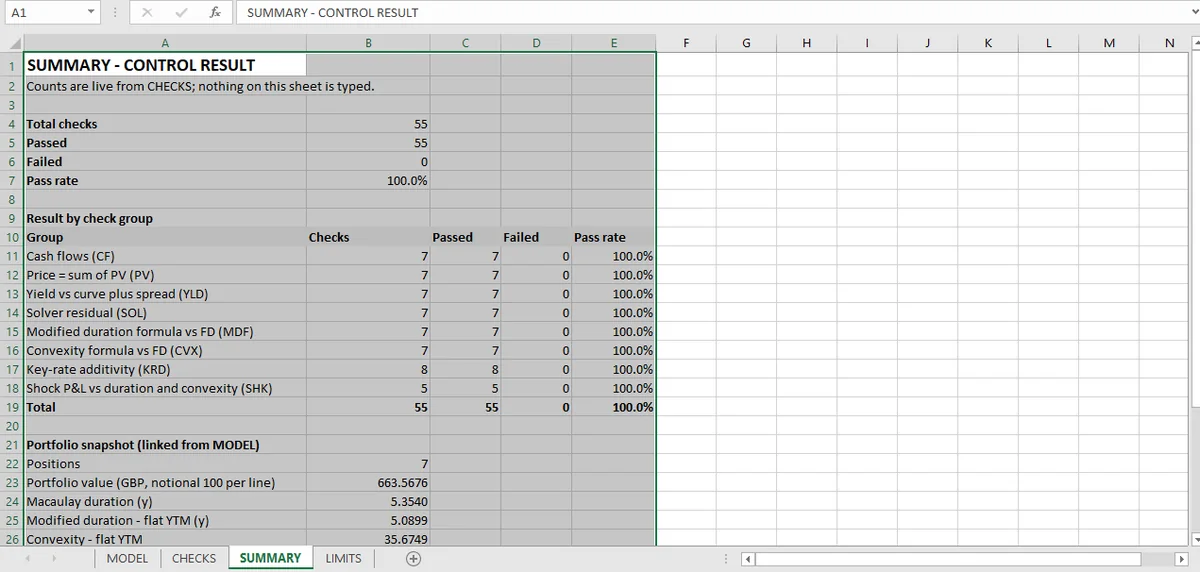
The Workbook's Own Caveat About What a PASS Means
The SUMMARY sheet carries a note, and it is the most important line in the workbook:
> A PASS means the two values agree within the stated tolerance. It is evidence of the arithmetic and the wiring of the model, not of the correctness of the inputs or of the market convention.
That is exactly right, and it is rare to see it stated. A duration that agrees with its finite difference is a duration computed correctly from the inputs; whether the inputs are the right curve, the right spread and the right convention is a separate question that no internal check can answer.
What this bookkeeping costs
Twice the formulas. Every bond carries two columns, one for each route, and the workbook is roughly twice the size it would be with one of each.
That cost buys something specific: a reader can check any number without trusting the formula. The finite difference is three prices and a subtraction; anyone can verify it. The closed form requires knowing the convention for the compounding frequency and the day count. Making that arithmetic visible is the point of an Excel model built for finance, rather than one that hides the check in a macro.
What the Bond Model Does Not Cover
Six limits that matter, in the workbook's own terms.
No bootstrapped curve. Key rates are inputs, not instruments.
No OIS or dual-curve discounting. One curve for discounting and projecting.
No day-count conventions or calendars. Simple year fractions, no odd periods.
No credit model. Spread is an input; no default, recovery or migration.
No optionality. All seven bonds are plain, so effective and modified duration never have to diverge for a structural reason.
No scenario set. Five parallel shocks, not a risk system.
How to read it in ten minutes
Open the SUMMARY and read the last line first, the one about what a PASS means. Then look at the tightest control: 43.6% of its tolerance. That number tells you the checks are neither trivial nor marginal.
Then pick one bond and follow its duration from the closed form to the finite difference. If the two agree, the analytic machinery is sound; if you can also reproduce the finite difference by hand, you have verified the model rather than trusted it.
That is the whole claim of this section, and it is a modest one: the arithmetic is right, the wiring is right, and the inputs are marked as inputs. The duration article is the best place to start, and the full 55-check run starts from the fixed income hub. The two analytic inputs are the yield solve and convexity.
The bond book Mica built lives in one workbook, so the analytic column and the bumped column share the same cash flows. That single-file arrangement is the local workbook model in practice.