

Where the spread lives in this model
A bond's yield equals the curve rate at its maturity plus its spread: 433.77 basis points for the first bond. The check is that the spread enters once. A model that adds it twice reconciles to itself and prices a bond that does not exist.
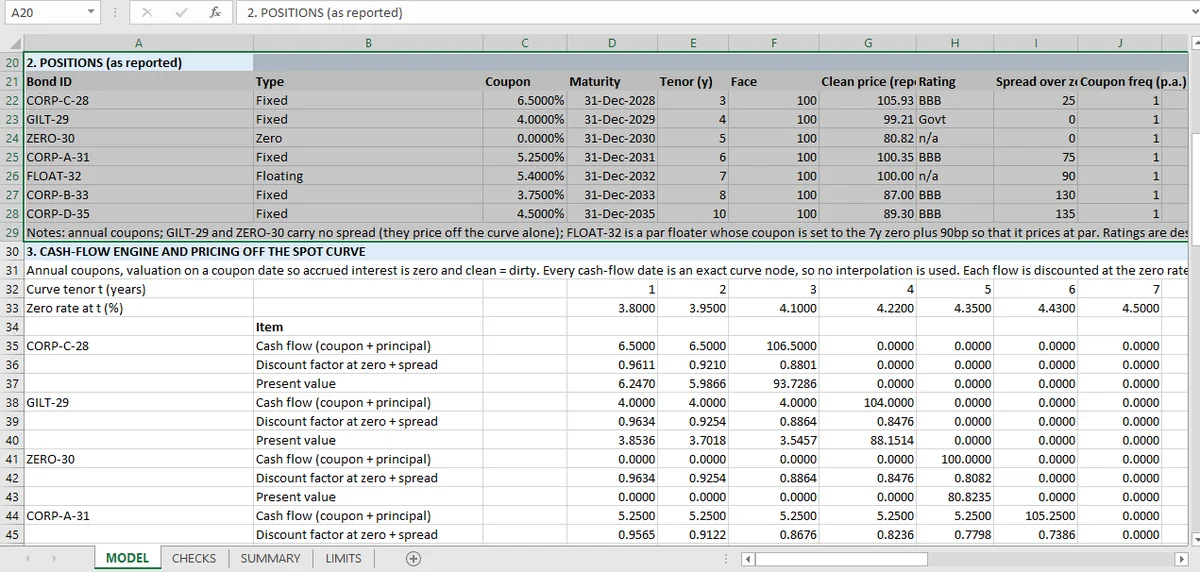
Each bond has a spread in basis points. The workbook's convention is that a bond's yield equals the curve rate at its own maturity plus that spread. The first bond comes out at 433.77 basis points over the curve.
The holdings were read from a position report image, and some fields needed more than one OCR pass. Every duration, convexity and key-rate check is computed from the same transcribed position, so a transposed coupon or spread is outside what they measure.
That is a quoting convention, not a model of credit. Nothing in the sheet estimates a default probability, a recovery rate or a hazard rate. The spread is an input that shifts the discount rate, and the checks confirm it is applied exactly once.
The Check: The Spread Is Added Once
The check confirms the spread is applied exactly once.
For each of the seven bonds, the solved yield is compared with the independently computed curve rate at maturity plus the spread. They agree, which establishes two things at once:
- the solver works, and
- the spread is not being applied twice.
The second is the one worth having. A model that adds the spread in the price calculation and again in the yield calculation will produce a price that is wrong and a yield that reconciles to itself. That is an internally consistent model of a bond that does not exist.
What the spread does to the analytics
Adding a spread to the discount rate changes price, duration and convexity together.
Price falls relative to the risk-free bond, by roughly the spread times the duration.
Modified duration changes slightly, because the denominator is one plus yield and the yield has moved.
Convexity changes slightly in the other direction, because higher discount rates reduce the present value weight of distant cash flows.
None of those is checked against an outside number, because the workbook has no external credit curve. What is checked is that the spread enters consistently wherever it enters. The price, the yield and the analytics are all built from the same discounted cash flows.
What an actual credit model would add
Three layers, each of which changes the analytics.
A hazard rate framework. Default probability per period, recovery on default, and a credit spread that is derived from them rather than assumed. In that framework the spread is an output, and a widening spread is a change in the hazard rate, not an input.
Spread duration. The sensitivity of the price to a change in the spread, separately from the sensitivity to the risk-free curve. For a credit portfolio this is often the dominant risk, and it is not in the workbook at all.
Correlation between the two. In a risk-off move, rates fall and spreads widen. A model that shocks them independently overstates the diversification between the two exposures. That is the correlation assumption correlation stress testing has to make explicit, because the diversification disappears exactly when it is needed.
The limits sheet is honest about the boundary: credit is a spread input, not a model of default. For a demonstration of price, yield and duration checks, that is the right scope. For a credit portfolio, it is the first thing to replace.
Why the convention matters
Two bonds quoted on different conventions (spread over the curve at maturity, spread over a constant maturity, or a full credit curve) will not be comparable. The workbook states its convention in a cell, and every bond is priced with it.
That single sentence is worth more than a page of credit analysis when the question is why two numbers disagree. Most spread discrepancies are convention discrepancies, and a model that does not name its convention cannot resolve them. Naming it in a cell is the workbook discipline that keeps two quotes comparable.
The yield article covers the solver side of the same convention, the shock test shows what happens when the curve moves but the spread does not, and the fixed income hub carries the complete 55-check sheet. The two analytics the spread shifts are duration and convexity.
The spread is a single input cell in the Mica build, so double-counting it is visible rather than internally consistent.