
The Portfolio Stress Test the Workbook Lacks
An optimized portfolio is optimal for the inputs it was given; a stress test asks what happens when those inputs are wrong. The workbook carries no scenario analysis, and the three checks that would keep one honest are fixed weights, one scenario for every asset, and asset P&L summing to portfolio P&L.
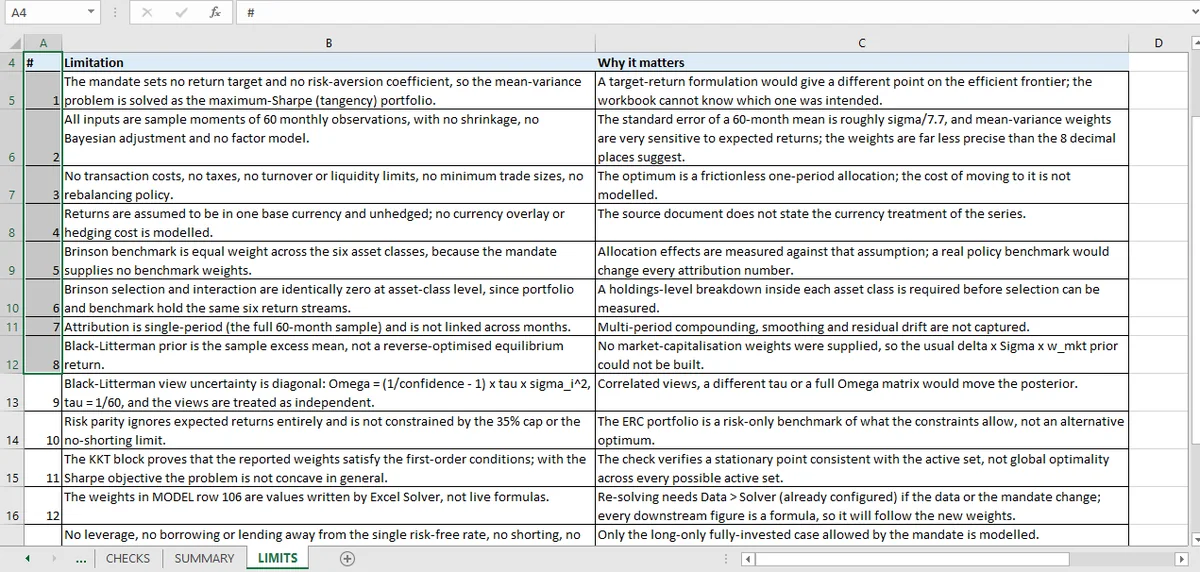
The portfolio workbook runs 24 checks and none of them is a stress test. The limits sheet does not list one either. It lists single-period, sample covariance, long-only and no transaction costs, but not "no scenarios".
That is the gap an allocator would notice first. An optimized portfolio is a statement about a covariance matrix estimated from 60 months; what it does under a badly different 60 months is not in the model.
What a portfolio stress test is
Three parts, and each has to be specified before anything is computed.
The scenario is a set of shocks: to asset returns, to volatilities, to correlations. A historical replay uses an actual month; a hypothetical uses a designed shock; a factor stress moves the factors and lets the covariance propagate.
The holdings are held fixed. This is the point of a stress test: it measures the portfolio you hold, not the portfolio an optimizer would choose afterwards.
The P&L is computed asset by asset and summed. If the sum does not equal the portfolio-level reprice, the scenario is being applied inconsistently.
The three consistency checks
Asset P&L sums to portfolio P&L. With fixed weights, the portfolio return is the weighted sum of asset returns. Any deviation is an arithmetic error or a currency effect that has not been modelled.
Every asset uses the same scenario. A scenario table that applies the shock to equities and forgets bonds produces a smaller loss and a false sense of diversification.
The stressed weights are the held weights. If the model rebalances inside the scenario, even implicitly by recomputing weights from stressed values, it is no longer testing the current portfolio.
Those three are cheap and they catch most of the ways a stress test misleads.
What a scenario should move
The obvious answer is returns. The useful scenario also moves the second moments.
In a crisis, volatilities rise and correlations converge toward one. A scenario that shocks returns but leaves the covariance matrix at its sample value will understate the loss on any portfolio with a risk model. The diversification benefit disappears exactly when it is needed. The credit market makes the same point in spread and rate correlation, where rates fall and spreads widen in the same move.
That is why correlation stress is usually quoted separately: "the portfolio loses 12% if equities fall 20%, and 19% if correlations also go to their crisis levels."
The reporting workflow that would consume the stress result is in the financial-report automation guide, and the Excel-for-finance guide covers the sheet mechanics.
Why this belongs after KKT
The KKT checks establish that the optimizer found the optimum for its inputs. A stress test asks a different question: what happens if the inputs are wrong.
Both matter, and they fail independently. A portfolio can be the exact optimum and a terrible holding; a portfolio can be robust and not optimal. The workbook covers the first and leaves the second to the reader.
That division is stated rather than hidden. The limits sheet's "single period" and "sample covariance" entries are exactly the assumptions a stress test would challenge.
What the optimizer proved is in the KKT article, and the allocation a stress test would compare against is risk parity. The constraints a stressed portfolio still has to meet are in the constraint scan, the assumptions being stressed are in Black-Litterman, and the portfolio hub gathers all 24 checks.
While a scenario is applied, Mica holds the weights fixed — which is the property a stress test needs.