

Risk Parity: A Different Objective From Mean-Variance
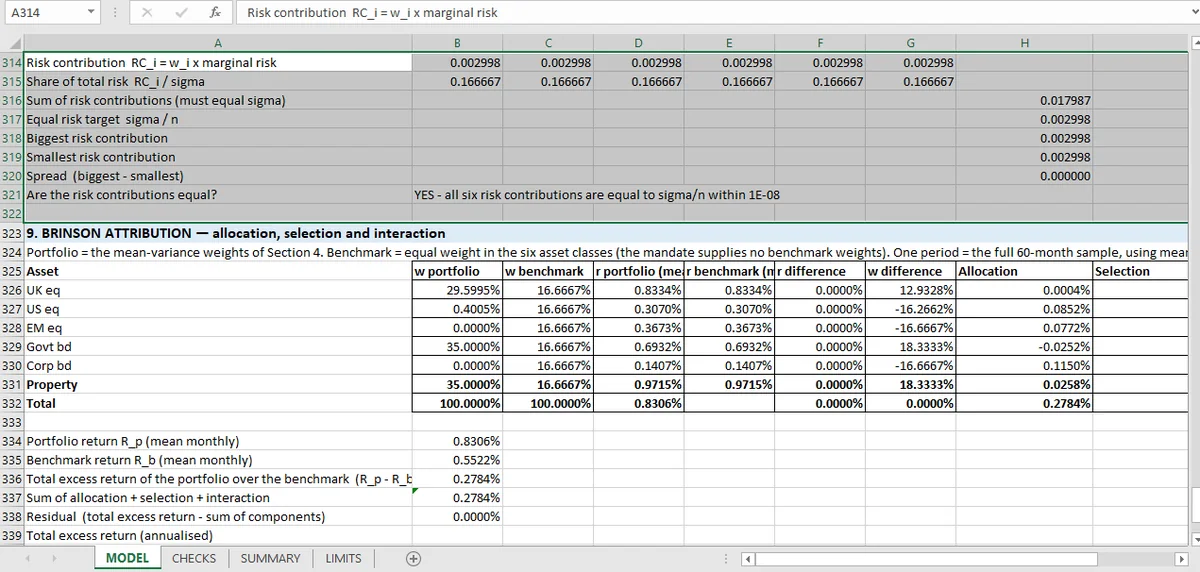
Risk parity ignores expected returns and equalises risk contributions instead. Three checks cover it: weights sum to one, contributions sum to portfolio volatility, and the largest and smallest contributions agree to the solver's tolerance. Here each asset contributes about 0.002998 monthly.
Mean-variance maximizes risk-adjusted return. Risk parity ignores expected returns entirely and equalizes each asset's contribution to total risk.
The workbook computes both. The optimized portfolio has an annualized volatility of 7.43%; the equal-risk-contribution portfolio comes out at 6.23%. Different objective, different portfolio, and the gap between them is a measure of how much the return forecasts are doing.
The three assertions
Risk parity is easy to state and easy to implement wrongly, and three checks cover it.
The weights sum to one. Same as any portfolio, and the same failure mode: a normalisation error that leaves cash uninvested.
The risk contributions sum to the portfolio's volatility. This is the definitional check. The contribution of each asset is its weight times its marginal contribution to volatility; summed, they must equal the total. Here the sum is 0.017987 monthly, matching the portfolio volatility of 0.017987.
The largest and smallest contributions agree to the solver's tolerance. The workbook reports the common contribution as 0.002998: not an exact equality, because the equalization is solved iteratively and stops at a tolerance.
That third number is the one to look at. A risk-parity solution with contributions of order 0.002 is not perfectly equal; it is equal to within the solver's tolerance, and the tolerance is a choice.
Why the definitional check matters
The additive identity, that contributions sum to volatility, is what makes the concept coherent. If a model computed contributions that summed to something else, the "equal risk" target would be equalizing a quantity that has nothing to do with the portfolio's risk. It is the same additivity that key-rate duration demands of a curve decomposition, applied to risk instead of price.
It is also a check that the covariance matrix is being used correctly. Contributions depend on marginal volatilities, which come from the covariance matrix; a mis-scaled matrix would show up here before it showed up in the weights.
What risk parity does not do
It ignores expected returns. That is the point, and it is also the limitation: equal risk is not equal reward, and in a period when one asset class outperforms, the portfolio will lag a return-aware allocation.
It is sensitive to the covariance matrix. Sixty months of sample covariance is the input, and risk parity inherits every estimation error in it. Shrinkage or a factor model would change the weights.
It has no leverage. A true risk-parity strategy often levers up to a target volatility. The workbook's allocation is long-only and unlevered, so it runs at 6.23% rather than at an equalised risk budget.
Comparing Risk Parity and Mean-Variance
The workbook reports both portfolios and their volatilities. What it does not report is the return of the risk-parity portfolio, or the Sharpe of either.
That is a gap a reader can close by hand, and the result is usually the interesting part: if equal risk produces a similar Sharpe with a different concentration, the allocation decision becomes a choice about governance rather than about returns. That comparison is the kind financial reporting automation should make routine rather than manual.
The mean-variance side has its own optimality conditions in the KKT article, and the constraint scan applies to both. Where the resulting returns come from is attribution, and all 24 checks sit in the portfolio hub.
Each risk contribution is computed in Mica as a formula over the covariance matrix, so the equalization can be checked rather than asserted.