

Residual Income Starts From Book Equity
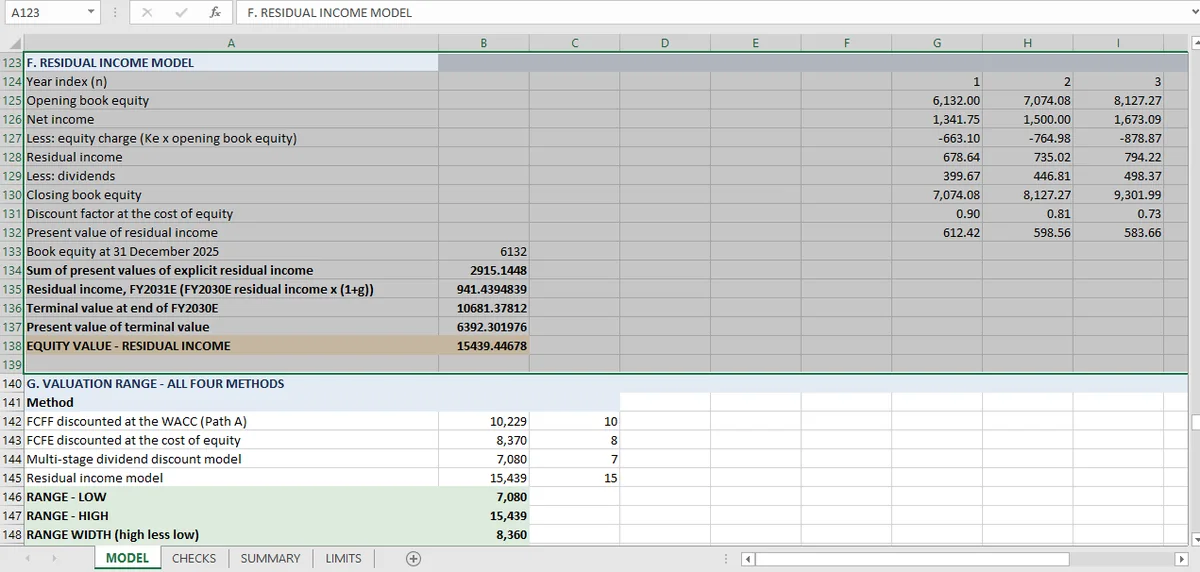
Residual income starts from book equity of 6,132 and adds 9,307 of present value, for 15,439. The terminal assumes residual income grows 2% forever, which implies a 17% return on equity against a 10.8% cost of equity.
The other three methods build a value from zero and ask what the business is worth. Residual income starts from what the accounting already says the equity is worth, book value, and adds the present value of whatever the business earns above the cost of that book.
In this workbook book equity at 31 December 2025 is 6,132, and the model adds 9,307 of present value on top, arriving at 15,439. That is the highest of the four methods, and the reason is partly structural: starting from a positive book value gives the model a floor that a pure cash-flow projection does not have.
What residual income is
Residual income in year t is earnings less a charge for the equity employed:
The charge is the opportunity cost. A company that earns 10.81% on book adds nothing; one that earns 17% adds 6.19 points of book value each year, and that excess is what the model discounts.
The identity is what makes the method tidy: value equals book value plus the present value of all future residual income. A check rebuilds it from book equity, the present value of the explicit period and the terminal, and confirms the sum is the reported value.
That identity also means the model cannot produce a value below book without implying the business will destroy value in every future year. Here it produces a value 2.5 times book, which implies a sustained return above the cost of equity.
The Terminal Assumption That Puts Residual Income at the Top
The explicit period runs five years. Everything after that is capitalized, and the terminal assumption is where the method earns its top-of-range position.
Residual income is assumed to grow at 2% in perpetuity. Because book equity also grows, holding that growth implies a return on equity of roughly 17% forever, against a 10.81% cost of equity.
The claim is strong: a business that earns 17% on equity indefinitely, with no competitive erosion, no reinvestment drag and no fade, is the best case in the workbook. The limits sheet says as much. It calls this "the most generous terminal assumption in the workbook" and the reason the RI model sets the top of the range.
The contrast with the DDM is exact. The dividend model holds payout at 29.8% and growth at 2%, which implies a terminal ROE of 2.85%. The residual income model holds growth at 2% and implies a terminal ROE of 17%. Same company, same forecast, two terminal assumptions that differ by a factor of six, and a valuation range that differs by a factor of two.
What Would Make the DDM and Residual Income Consistent
If both models were given the same terminal economics, they would converge. The relationship is:
and terminal RI depends on terminal ROE through the book. Set ROE equal in both models and the terminal values become two ways of writing the same number.
Nothing in the workbook forces that. Each method carries its own terminal block, and the checks confirm each block is internally consistent. The model does not check that the blocks agree across methods.
That is a gap worth naming, because it is the difference between a set of valuations and a valuation framework. Four methods that disagree because they assume different perpetuities is a range. Four methods that disagree while claiming the same perpetuity would be a bug.
Reading a residual income valuation
Three things to look at, in order.
Book value relative to value. Here it is 40% of the answer. When book value is most of the valuation, the model is largely an accounting statement; when it is a small fraction, the valuation is all terminal assumption.
The implied return on equity. 17% forever is the number to argue with. A reader who thinks competition erodes returns should re-run the terminal at a lower ROE and watch the value fall. In a linear model the terminal is a large share of the total, so the sensitivity is high.
The cost of equity. 10.81%, derived from the WACC using book weights. The limits sheet notes that iterating on market-value weights would lower Ke, and because Ke appears both as the discount rate and inside the residual income charge, a lower Ke raises the value twice over.
Residual income is the method that most directly connects an accounting number to a valuation, which makes it the easiest to explain and the easiest to overstate. The 15,439 is not a better answer than the 7,080 from the DDM; it is the answer to a more optimistic terminal assumption, and the two belong in a range together. The range article does that assembly; the DCF routes bracket it from below; and the valuation hub gathers the complete check sheet. The dividend model at the bottom of the range is here.
Book value and the residual income charge sit in separate named cells in the Mica build, so the terminal assumption can be changed and the effect seen immediately.