

A financing structure is four numbers and one assumption
Moving the debt share from 40% to 60% cuts the WACC by 1.24 points if beta is held fixed, and by 0.19 once the equity beta is relevered. Only the second number is a financing benefit.
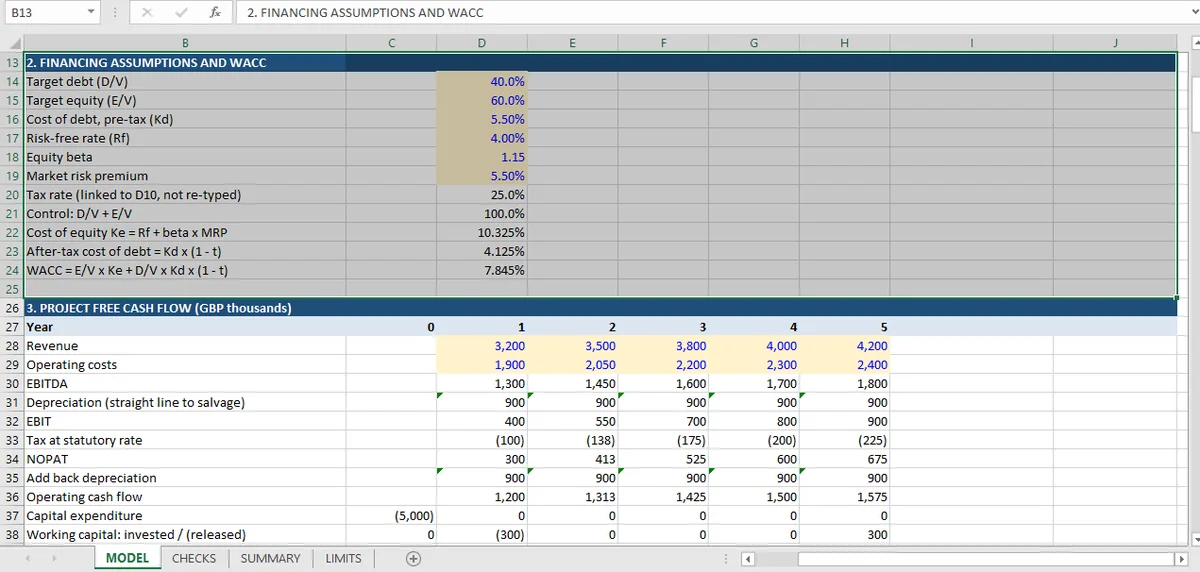
The appraisal behind this series is financed at 40% debt and 60% equity, with a cost of debt of 5.5%, a risk-free rate of 4%, an equity beta of 1.15 and a market risk premium of 5.5%. Those produce a cost of equity of 10.325%, an after-tax cost of debt of 4.125% and a WACC of 7.845%.
Change the debt share and the WACC changes, because the weights change. That much is arithmetic: every model will show it, and the check that the WACC equals Ke less the debt share times the spread between Ke and the after-tax Kd will still pass, because it is an identity.
The interesting question is what else moves. In a fully linked financing model, raising leverage also raises the cost of equity, because equity becomes riskier. The two effects largely cancel. In this workbook, the beta is an input and nothing relevers it, so only one of the two effects exists. That is worth demonstrating rather than asserting.
What moves when the debt share moves
Hold the cost of equity and the cost of debt at their base values and change only the debt share. The WACC is a straight line between 10.325% at no debt and 4.125% at all debt:
| Debt share | WACC | NPV |
|---|---|---|
| 20% | 9.085% | 623 |
| 40% (base) | 7.845% | 836 |
| 60% | 6.605% | 1,062 |
| 80% | 5.365% | 1,301 |
The NPV column is the same cash flows discounted at each rate using Excel's NPV function; the base row reproduces the workbook's 836 exactly, which is the check that the recomputation is the same calculation.
Read alone, that table says leverage is free value: the 60% row is 226 above the base case. Every point of debt share lowers the discount rate by about 0.062 percentage points and adds roughly 11 of NPV. At 80% debt the project is worth 55% more than at 40%, for no change in the cash flows.
That conclusion is wrong, and the reason it is wrong is the assumption the table holds fixed.
What Should Move With Leverage: Beta and the Cost of Equity
Equity in a levered firm is riskier than equity in an unlevered one. If the debt share rises, the equity beta should rise with it, and the cost of equity should follow. The standard relationship is Hamada's:
Unlever the base case (βL of 1.15 at a debt-to-equity ratio of 0.667) and βU is 0.767. Relever that at 60% debt, where D/E is 1.5, and βL becomes 1.63. The cost of equity rises to 12.96%, and the WACC becomes:
| Debt share | WACC, beta held | WACC, beta relevered |
|---|---|---|
| 20% | 9.085% | 8.031% |
| 40% | 7.845% | 7.845% |
| 60% | 6.605% | 7.659% |
Relevered, the WACC barely moves: 7.845% to 7.659% on a 20-point shift in the debt share. The whole 1.24-point fall in the unadjusted table is the missing risk adjustment, not a financing benefit.
On a three-statement model the same choice shows up in the interest line, where debt and cash balances feed interest and interest feeds the balances; the three-statement checks cover the circularity that creates.
This workbook uses the unadjusted version, and its limits sheet says so: beta is used as given, with no relevering from comparables, no debt beta, and a 40/60 structure assumed constant over five years. The choice is defensible for a five-year appraisal: relevering brings a debt beta, a comparable set and an assumption that the capital structure is stable. The choice still has to be disclosed, because the sensitivity it produces is not a sensitivity to financing policy. It is a sensitivity to the weights in a formula.
Why the WACC Check Still Matters
The identity check is worth running, but it is conditional on the structure: it confirms the WACC is built from the four inputs rather than typed, and that the weights reconcile. It does not test whether the cost of equity moved with leverage. If a model failed that check, the sensitivity above would be meaningless, because the thing being varied would not be the thing in the formula.
There is a second check available that the workbook does not carry: change the debt share, and assert that the cost of equity changed too. The check is on the model's structure rather than its arithmetic; it would fail in this workbook, and failing is the correct result. Writing checks that encode the structural expectation is how a model makes its own limitations visible.
What makes that practical is a workbook where inputs and calculations are different cells. Then a scenario change leaves a trail from input to output. That is what turns "change the debt share" into a test rather than an edit.
What a correct financing linkage looks like
Three things move together when leverage changes in a properly linked model:
- The cost of equity, through the relevered beta.
- The cost of debt, usually, because more leverage means a worse credit and a higher spread. The workbook has a single Kd with no margin ratchet, so this channel is closed too.
- The weights, as the debt share changes.
Only the third is modeled here. A model with all three would show the WACC moving much less than the table above, and the difference between the two tables, 1.24 points against 0.19, measures how much the missing channels are worth.
What the model would need to test financing policy
Three additions, and each one closes a channel that is currently open.
A relevering routine. Unlever the observed beta once, then relever it at each candidate structure. It needs a comparable set, a debt beta (or an explicit assumption that it is zero), and a decision about whether the tax shield is certain. In the illustration above it turns a 2.48-point WACC range into a 0.37-point one.
A debt spread schedule. The cost of debt is a single 5.5% with no margin ratchet. In reality a higher debt share means a worse credit, and the spread moves with the structure. The limits sheet says there are no covenants, no margin ratchet and no arrangement fees, which is what makes the single Kd defensible for a five-year appraisal and what makes it useless for a financing-policy question.
A structural assertion. Once the other two exist, the check becomes: change the debt share, and assert that the cost of equity moved in the right direction, by a plausible amount. That check fails in this workbook, and it should.
For the project decision, the practical consequence is that the financing-structure sensitivity should not be used to argue for more leverage. The base case clears the hurdle at 7.845%; the WACC sensitivity shows how far the rate can rise before the answer flips; and the leverage table shows how little a relevered WACC would actually move. The integration article covers how these checks fit together, the metric comparison shows what a WACC change does to the IRR and MIRR as well, and the capital budgeting hub gathers the full set.
Assumption inputs and calculated cells are kept apart in the Mica build, so moving the debt share leaves a visible trail from input to output.