
A binary tree over observed returns
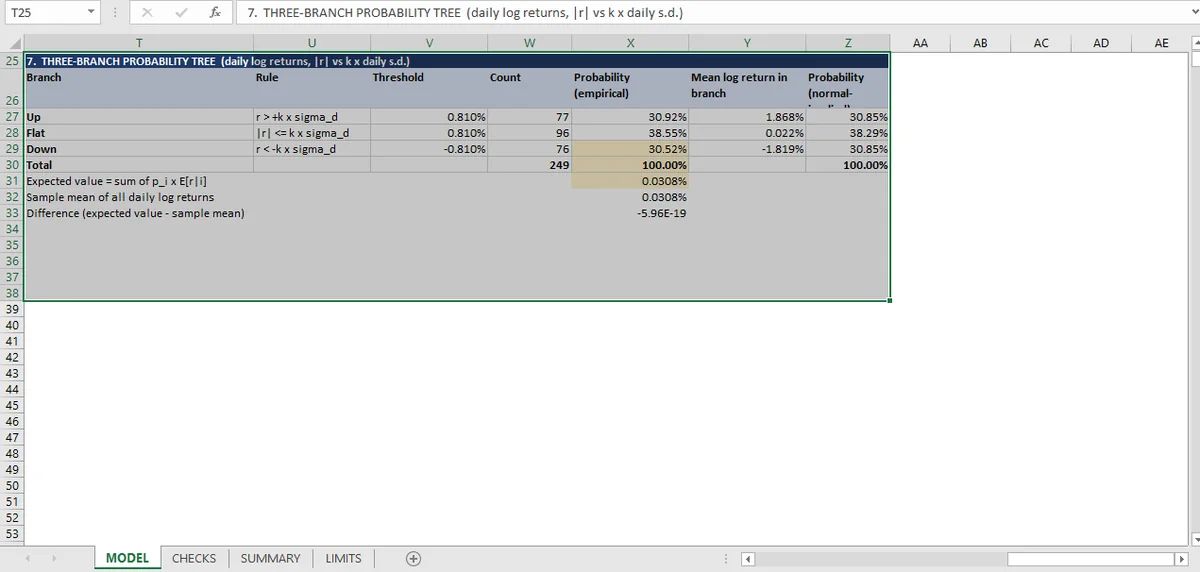
A two-branch tree over 249 daily returns has to satisfy three things: probabilities sum to one, branch counts sum to the sample, and the expected value rebuilds from both. The empirical up-branch probability is 0.3092 against a normal-implied 0.3085.
The workbook builds the simplest possible probability tree from the price series: each of the 249 daily log returns is classified as an up day or a down day, and the empirical probability of each is computed from the counts. An up day is a return at least half a standard deviation above zero — the threshold that makes the normal-implied probability 30.85% rather than 50%.
Two things are then checked, and a third follows from them.
The probabilities sum to one. Up plus down equals 1 exactly, not approximately. That is trivial arithmetic and it is also the check that catches a classification rule with a hole in it. A threshold that excludes zero returns, for example, would leave some days in neither branch.
The branch counts sum to the observation count. Up-branch count plus down-branch count equals 249. This is the check that probabilities cannot fake: if the two percentages sum to one but the counts do not sum to the sample, one of the branches is computed over a different row range.
The expected value rebuilds from both. The probability-weighted sum of the branch values has to equal the expected value computed independently. The difference here is 6 × 10⁻¹⁶.
The normal-implied probability
The interesting check is the fourth. The tree's up-branch probability can also be derived from a normal distribution fitted to the same returns, and the two should be close.
| Source | Up-branch probability |
|---|---|
| Empirical count | 0.3092 |
| Normal-implied | 0.3085 |
The gap is 0.0007, or seven basis points of probability. That is what a normal fit on 249 observations should produce, and it is evidence of two things at once: that the classification is counting correctly, and that the returns are not wildly non-normal at this sample size.
Nor does it prove returns are normal. A 0.07% gap in the up-branch probability is a weak test. The up/down split is the coarsest summary of a distribution, and a series with fat tails can match it exactly while failing at the 1st and 99th percentiles.
What the tree is for
A two-branch tree over daily data is not a serious model of uncertainty. It is a teaching structure: the smallest object that has probabilities, branches and an expected value, and therefore the smallest object on which the three consistency checks can be run.
That is why it belongs in a check sheet. Every larger model has the same three requirements: a decision tree, a scenario tree, a lattice. A model that fails them at two branches will fail them at two hundred.
The pattern to carry forward is the third check. Probabilities and counts are both easy to get internally consistent; rebuilding the expected value from both, and comparing, is what catches a branch computed over the wrong range.
The Monte Carlo article replaces the two branches with 10,000 paths and keeps the same idea: compare what the simulation produced against what the distribution implies. All 31 checks, with their cell references, are in the quantitative hub. The returns feeding those branches are in returns and time value, and the beta estimated on the same series is in the regression.
Counts and probabilities are kept apart in Mica, so the reconciliation is arithmetic rather than an assertion.